
World PC shipments rose 3.2% in the first quarter, but the rise in memory costs is frightening consumers
Brief Summary
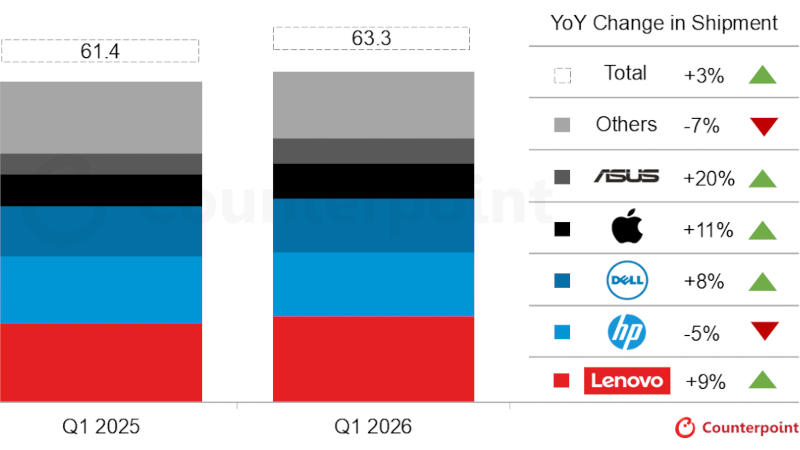
In the first quarter of 2026, global revenue from personal computer (PC) sales increased by 3.2% compared with the same period last year and reached 63.3 million units. The growth is explained by higher prices for memory and the need to upgrade systems due to the end of Windows 10 support.
1. Overall Market Dynamics
Indicator Value Total Shipments (Q1) 63.3 million units Year‑over‑year increase +3.2%
Key drivers of growth were:
- Rising DRAM costs – prices almost doubled in the first quarter.
- Transition to newer Windows versions – 40% of work PCs still run on Windows 10 and require an upgrade.
2. Market by Major Brands
Brand Sales (million) Year‑over‑year increase Market Share
Lenovo 16.5 +9% 26% – record level for the entire observation history
HP +5% leads over Dell
Dell +8% (commercial sector) third place
Apple 6.7 +11% thanks to the new MacBook in March
Asus 4.8 +20% steady demand for laptops
The five leading manufacturers hold almost 80% of the global PC market. Smaller brands see stagnation or declining sales volumes.
3. Pricing and Outlook
- The average selling price (ASP) will rise, while shipment volumes are expected to decline.
- Investments in artificial intelligence could depress prices for processors and other components, negatively impacting PC market growth in 2026.
- Despite this, the downturn will be less pronounced than in other consumer electronics segments because a significant portion of the fleet still needs upgrading.
4. Future Trends
Trend Description
Emergence of PCs on Qualcomm processors – sustained demand is expected due to new Intel and AMD chips supporting AI.
Demand in 2026 – driven mainly by short‑term factors (expectations of memory price increases, Windows 10 upgrades). These factors stimulate sales but do not guarantee long‑term growth.
Memory supply issues – a DRAM and NAND shortage is anticipated in 2027, which could stabilize the market after a period of declining sales.
Test for manufacturers – success will depend on the ability to secure reliable supply chains and shift to more profitable mid‑range and premium segments.
Conclusion
The first quarter of 2026 showed moderate growth in PC sales volumes, while prices for key components continue to rise. The market is undergoing a consolidation phase: large brands hold nearly 80% of the share, and smaller companies face challenges. In the coming years it will be critically important for OEMs to ensure supply stability and adapt their portfolios toward higher margins in mid‑range and premium segments.
 Asted Cloud
Comments (0)
Share your thoughts — please be polite and stay on topic.
Log in to comment