
A quantum dot developer for TV identified weaknesses in RGB‑LED panels
Display Week: Nanosys questions the popularity of Micro‑RGB and Mini‑RGB
At the annual Display Week event in Los Angeles, quantum dot developer (SQD) – Nanosys – criticized a competing solution based on LCD panels with RGB backlighting. These panels, known under the brands Micro RGB and Mini RGB, are considered one of the most discussed tech trends this year.
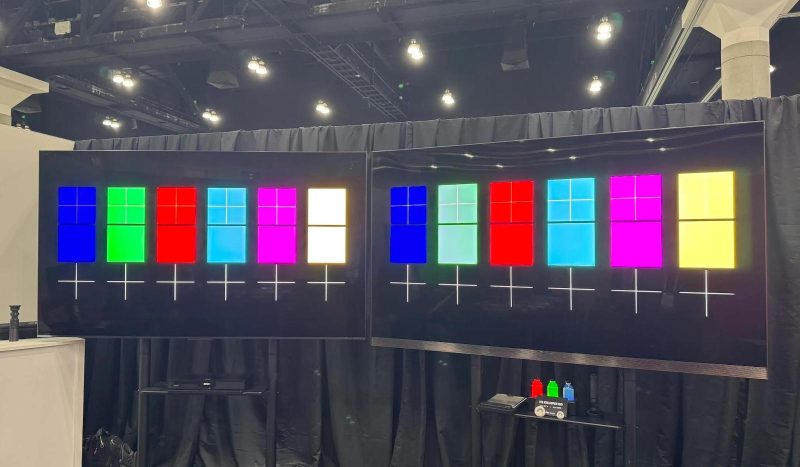
Demonstration: two TVs – one idea
Nanosys prepared two 85‑inch televisions for the showcase:
| Television | Backlight technology | Description |
|---|---|---|
| TCL X11L | mini‑LED + quantum dots (SQD) | Shown as an example of “pure” technology |
| Unidentified brand | RGB‑LED | The system groups red, green and blue LEDs into separate zones |
Both devices played the same video content. Simple graphic tests were displayed on the screens: three rows of squares – two with primary colors and additional shades, the third a thin white cross on a black background beneath each colored square.
What viewers saw
RGB‑LED panel
* When the white cross appeared in the top row, the area around it slightly lightened, and the saturation of the main color decreased.
* Crosstalk distortion was observed not only in the top but also in the bottom row: colors from the middle row “bleed” into the row with crosses.
* In arbitrary images, a change in skin tone could be noticed – if the screen showed red clothing, the skin also took on a slightly reddish tint.
SQD TV
* No cross‑color distortions were observed.
* Contrast was significantly higher: TCL X11L offers from 14,400 to 20,000 dimming zones, whereas the RGB‑LED panel has only 8,000. This is because in SQD technology each zone is controlled by a single LED, while an RGB‑LED requires three (one for each color), reducing control precision.
Conclusion
Although RGB backlighting promised brighter and more saturated colors, it leads to cross‑color shift – “color noise” around objects. In 2026, SQD remains a notable advantage due to the absence of such distortions and higher contrast.
Nanosys emphasized that RGB‑LED solutions are still in early development stages and may improve over time, but currently quantum dot technology demonstrates more reliable results.
 Asted Cloud
Comments (0)
Share your thoughts — please be polite and stay on topic.
Log in to comment