
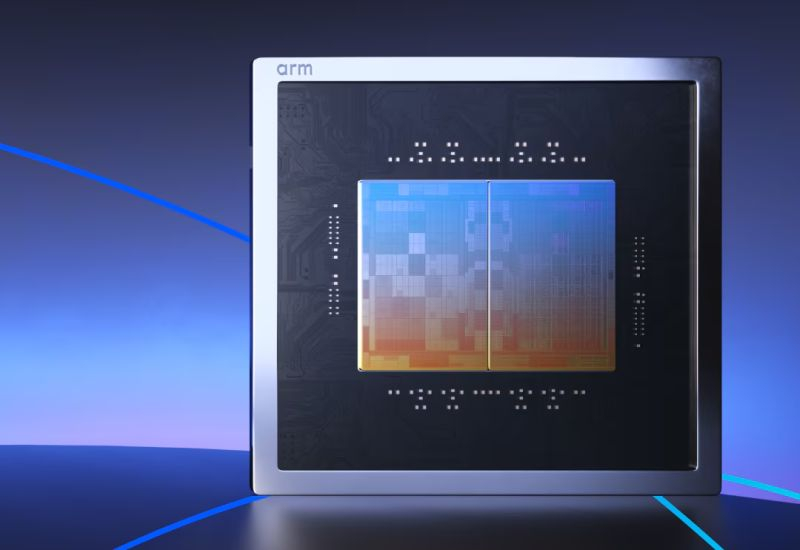
Arm is banking on launching 512‑core processors in the server segment to establish itself as a leading supplier.
Arm Announces Plans to Scale Its Central Processors
Until recently Arm was known only for developing processor architectures, and analysis of its quarterly reports remained rare. With Arm’s entry into the CPU market, the situation changed dramatically: at the latest conference, company leadership stated that their central processors could dominate the server segment by planning to increase core counts to 512.
What Competitors Were Saying
At recent quarterly meetings, Intel and AMD executives noted a shift in the balance between CPUs and GPUs in server infrastructure. Previously GPUs were the undisputed leader for large-scale AI model training, but now their share is declining. In an interview with a J.P. Morgan analyst, Arm CFO Jason Child expressed agreement with AMD CEO Lisa Su, who predicts that the central processor market will reach $120 billion by 2030—slightly above Arm’s earlier expectation of $100 billion.
Arm’s Core Plans
Child emphasized that “we see not only explosive demand for CPUs but also a drive to increase core counts on chips.” Already, Arm AGI processors are equipped with 136 cores—a figure already higher than most competitors. He added: “In the future we could see models with 256, and possibly even 512 cores. That’s an excellent opportunity for Arm because with such a high core count, per-core efficiency becomes critically important, and that’s where we lead.”
Hyper‑Scaler Support
Arm CEO Rene Haas noted that all major hyper‑scalers, including Nvidia, use Arm technologies. Currently the leading accelerators are Google TPU, AWS Trainium, and Nvidia Rubin—all based on Arm architecture. According to him, Arm will ultimately capture the entire market for AI infrastructure components.
Why CPUs Remain Relevant
GPUs already face physical limits: crystals grow to their maximum sizes, and photomasks approach technological boundaries. In contrast, central processors can quickly increase core counts—over the next few years their numbers could double or quadruple. Intel and AMD are already working on 256‑core and even 512‑core models, confirming a trend toward “many‑core” CPUs.
Thus, Arm declares its readiness to compete in the server market by offering highly efficient many‑core processors that could become key components of AI infrastructure in the coming years.
 Asted Cloud
Comments (0)
Share your thoughts — please be polite and stay on topic.
Log in to comment