
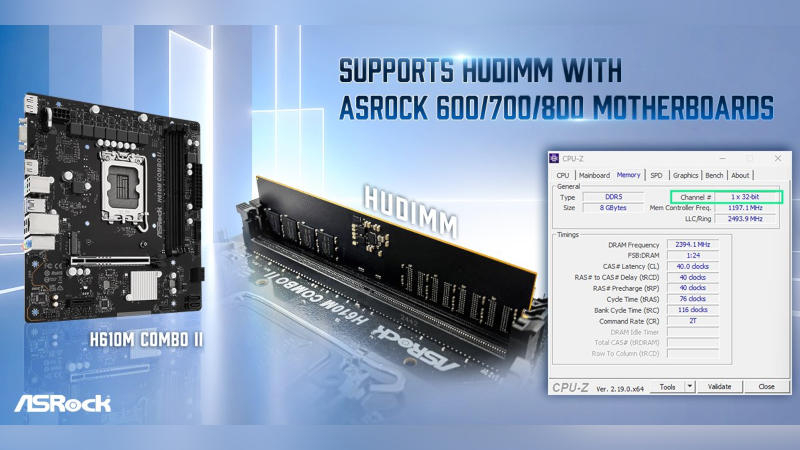
ASRock and TeamGroup have created a budget DDR5 module called HUDIMM for economical computers
ASRock Expands DDR5 Memory Support
ASRock has announced that its motherboards on Intel 600/700/800 chipsets now support DDR5 HUDIMM modules with a single 32‑bit subchannel. This innovation is intended to make next‑generation memory more accessible, although it will reduce its maximum performance.
Why It Matters
- Demand for Budget Modules
ASRock noted that the market is experiencing high demand for inexpensive DDR5 modules. A single‑subchannel HUDIMM can lower component costs without significant loss of functionality, which is especially relevant amid a chip shortage.
- Partnership with Suppliers
The manufacturer has already attracted attention from major module producers who will help bring HUDIMM components to market in volume. This will accelerate availability of new modules for end users.
Industry Reaction
Intel welcomed the initiative, stating that it will help boost DDR5 sales amid global memory shortages and rising prices of finished devices. TeamGroup highlighted that the single‑subchannel technology doubles chip savings per module, lowering its price while meeting growing demand.
How It Works
- Standard DDR5 uses two 32‑bit subchannels, providing high performance for large modules.
- In today’s market conditions, such an approach is not always justified.
- ASRock demonstrated that in some configurations a single subchannel can even increase throughput: on the H610M COMBOII board, an 8 GB module with one subchannel and a 16 GB module with two subchannels run faster than a single 24‑GB module with two subchannels.
Support in Compact Systems
In its DeskMini lineup, ASRock also implemented support for single‑subchannel modules – the HSODIMM DDR5 format. This makes memory more flexible and cost‑effective even for small form factors.
Thus, HUDIMM with a single 32‑bit subchannel opens a new path to reducing DDR5 memory costs without sacrificing key characteristics, benefiting both manufacturers and end users.
 Asted Cloud
Comments (0)
Share your thoughts — please be polite and stay on topic.
Log in to comment