
Astronomers can now reconstruct a galaxy’s history based solely on a single photograph
New “galactic archaeology”: how one image reveals billions of years of history
A promising method has emerged in astronomy that allows the development of any galaxy to be reconstructed from a single image, covering the entire history of the Universe. It is similar to learning about a person from one photograph—where they lived, who they met, and how they became what they are.
Key element – artificial intelligence
The method uses AI to analyze the chemical “fingerprints” of substances in a galaxy. By examining the composition of elements and their distribution, researchers attempt to reconstruct all major events: star formation, supernova outbursts, black hole activity, and galactic mergers.
Pilot example – NGC 1365
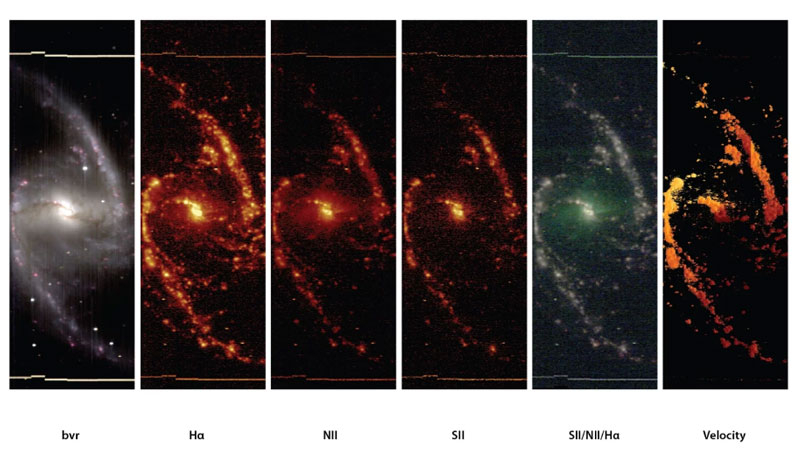
Scientists tested the method on the spiral galaxy NGC 1365. The center of this galaxy formed about 13.7 billion years ago—almost immediately after oxygen began to form in the early Universe. In the following 12 billion years, the outer parts of the galaxy grew through numerous mergers with dwarf satellites that brought in additional gas and stars.
The gradient of oxygen distribution has already provided valuable information about its evolution, but plans are underway to expand the analysis to other elements to improve model accuracy.
How a galaxy’s “biography” is created
To reconstruct the history of NGC 1365, astronomers used real observations from the TYPHOON project. First they tested over 20,000 simulations to ensure that the models fully matched the data. After that, the algorithm was “directed” at the specific galaxy. Machine learning was able to recover the main stages of its development.
What this means for science
The method opens a new path for studying the Universe: now it is possible to quickly obtain evolutionary chronicles of a vast number of galaxies, which will help better understand cosmic processes and humanity’s place in this grand context.
 Asted Cloud
Comments (0)
Share your thoughts — please be polite and stay on topic.
Log in to comment