
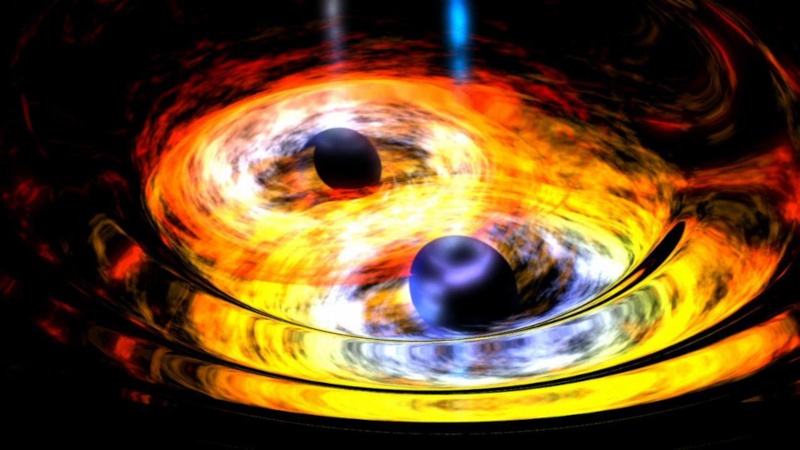
Black holes of the heaviest masses are formed not from stars but by the merging of large voids, scientists have discovered
New Perspective on the Origin of the Most Massive Black Holes
Scientists, having examined 153 black‑hole merger events catalogued in GWTC‑4, concluded that objects with masses exceeding about 45 M⊙ do not form directly after stellar death. Instead, they are assembled in dense clusters of old stars where existing black holes frequently collide and merge.
What Was Studied
- Events: 153 registered black‑hole mergers detected by LIGO, Virgo, and KAGRA.
- Goal: determine how the heaviest objects appear—immediately after the collapse of a supermassive star or through a series of subsequent mergers.
Key Findings
1. Two Groups of Black Holes
- *Low masses* (up to ~45 M⊙) – likely born from core collapse of massive stars during supernova explosions.
- *High masses* (> 45 M⊙) – their spin and orientation suggest multiple mergers within dense clusters.
2. The “Mass Gap” Problem
Theory predicts that stars in a certain mass range leave no black hole after death: the explosion completely disrupts the core. The lower edge of this gap is around 45 M⊙. Thus, direct formation of more massive black holes from a single star is unlikely.
3. Chain‑Merger Scenario
- After the first merger, the mass increases, and in a dense cluster the probability of a second collision rises.
- This process builds objects exceeding 45 M⊙.
What Experts Say
- Izobel Romero‑Show: “High‑mass black holes spin faster, and their orientation axes appear random—exactly the signal we expect from multiple mergers in clusters.”
- Fabio Antonini (Cardiff University): “The question now is not only how these objects form but whether they alter our models of stellar evolution.”
Conclusion
The results underscore the importance of dense star clusters in creating the heaviest black holes detected by gravitational waves. This discovery challenges traditional views of direct massive‑black‑hole formation from single stars and highlights the need to incorporate multiple mergers into compact‑object evolution models.
 Asted Cloud
Comments (0)
Share your thoughts — please be polite and stay on topic.
Log in to comment