
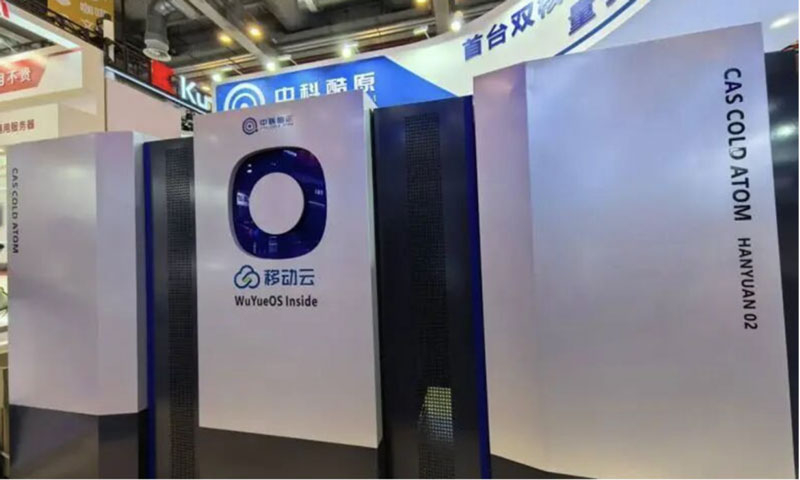
China has developed the world's first "dual-core" quantum computer, easily scalable in size
Chinese “dual-core” quantum computer: what is known
In 2024, dual‑core processors became a key breakthrough for classical computers, opening the way to parallel task processing and significant performance growth. A similar leap is expected in quantum computing—and according to Chinese sources, it has already occurred.
What was presented
The Chinese company CAS Cold Atom Technology (a spin‑off of the Chinese Academy of Sciences) announced the launch of the Hanyuan‑2 system, which it called the world’s first “dual-core” quantum computer based on neutral atoms.
- Size: 200 qubits formed from two rubidium isotopes—100 Rb‑85 atoms and 100 Rb‑87 atoms.
- Architecture: two independent arrays of neutral atoms that can operate in parallel or in a “core + auxiliary” mode. The second core forms logical qubits for error correction, increasing stability and scalability.
How it works
Neutral atoms are trapped and manipulated with laser beams. This approach allows:
- Reducing interference between neighboring qubits.
- Increasing array size without significant loss of quality.
- Saving energy—the system consumes less than 7 kW and does not require the cryogenic conditions typical for superconducting quantum computers (IBM, Google, etc.).
Why it matters
Neutral atoms are considered one of the most promising paths to scaling quantum systems. Their advantages:
- Rapid increase in qubit count.
- Lower cooling requirements compared to superconducting qubits.
- Ability to be housed in ordinary server rooms thanks to a compact, rack‑mount design.
Google has already recognized the potential of this technology and incorporated neutral atoms into its long‑term plans, seeing them as an easy way to expand quantum computing.
What remains unclear
- Independent verification: there are no third‑party confirmations of the developers’ claims.
- Technical details: data on gate fidelity, coherence time, and entanglement level are missing.
- Benchmarks: test results or evidence of practical quantum advantage have not been published.
If all stated characteristics are confirmed, Hanyuan‑2 could become a significant step forward in the development of quantum computing and open new possibilities for scalable systems.
 Asted Cloud
Comments (0)
Share your thoughts — please be polite and stay on topic.
Log in to comment