
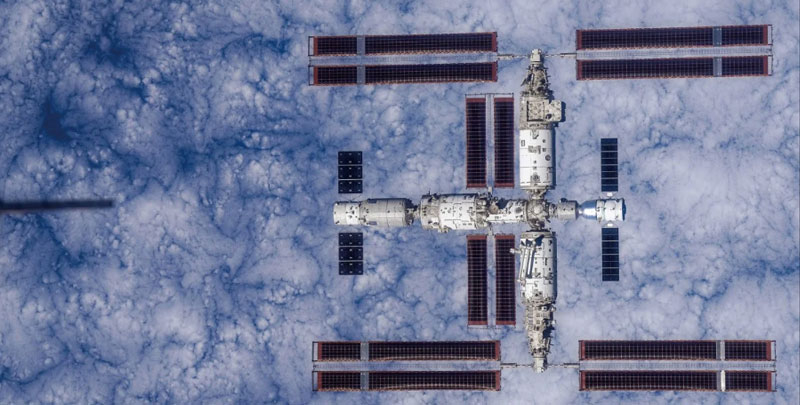
China will double the size of TianGong by the time the ISS is flooded
China is preparing “Tiangong” for a large-scale expansion— the station will become the largest low‑Earth orbit platform after 2031
1. What already exists
* Start of operations – 2022.
* Shape – T‑shaped, composed of three modules:
* Core “Tianhe” (basic module)
* Two science modules
* Parameters
* Habitable volume ≈ 110 m³
* Mass ≈ 90 t (half the mass of the ISS, which is ~400 t)
More than 260 experiments have already been conducted aboard and 26 spacewalks performed. The amount of available space for crew and equipment is growing faster than its demand.
2. Planned expansion
Stage | What is added | How the configuration changes
---|---|---
1 | Multifunctional compartment (new hatch, additional berthing ports) | T‑shaped station becomes cruciform
2 | Two laboratory modules | Total number of modules – 6
Result | Mass ≈ 180 t (more than twice current)
China expects that after the expansion the station will be able to host up to six crew members simultaneously and support long‑duration scientific missions.
3. Why this matters
* Scientific necessity – already more than 260 experiments; an increase in international projects is expected (Pakistan, Hong Kong, Macau, UN).
* International presence – China aims to become a key player in low‑Earth orbit infrastructure.
* Continuity of crewed activity – with a planned lifespan of 15 years the station will be the only active low‑orbit platform while the U.S. program shifts focus to the Moon.
4. Technical challenges
1. The new module exceeds the size of the base “Tianhe” → requires a larger hatch and additional berthing ports.
2. The “Changzheng‑5B” rocket – in its current configuration cannot deliver the new compartment.
* Need to increase payload volume, add a fairing and/or more powerful boosters (or an extra stage).
3. Manipulators – upgrade robots for handling larger modules.
5. What else is expected
* Orbital telescope “Xuntian” – a key element that should complement the station and popularize space research. Its launch is delayed; China hopes to deliver it by the end of this year.
6. Conclusion
China is actively building a plan to double the size of “Tiangong” to ensure long‑term human presence in low Earth orbit and become one of the leading space powers after 2031. The plans earn respect, but questions remain about the launch timeline for the “Xuntian” telescope – its appearance will be an important step in popularizing space science.
 Asted Cloud
Comments (0)
Share your thoughts — please be polite and stay on topic.
Log in to comment