
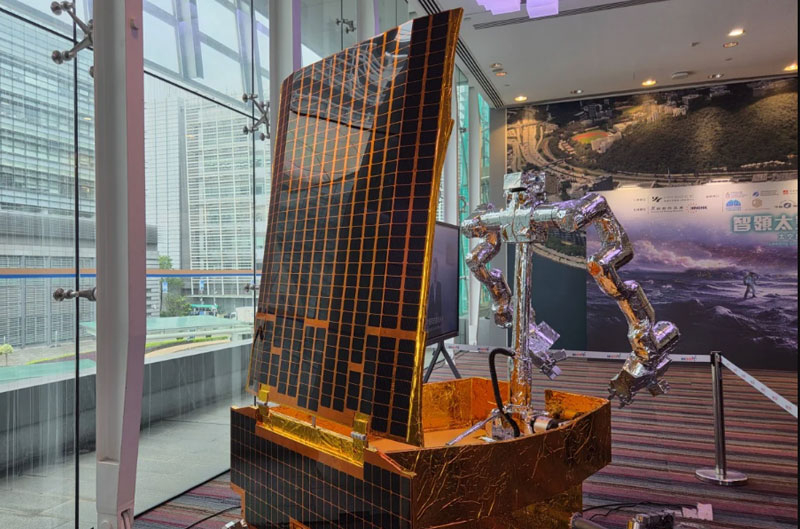
China will send "centaurs" to the Moon—humanoid robots on wheeled platforms
China is preparing “human-like” lunar rovers for the Moon’s south pole
It has recently become known that in the coming years China will launch two unusual missions to deliver new rovers with a “human” torso to the Moon. These vehicles will combine a wheeled base and two manipulator arms, allowing them to perform complex operations: deploy equipment, mount sensors, and collect regolith samples.
What is said about the Chang’e‑7 mission
Professor Gao Yang from HKUST mentioned that within the framework of Chang’e‑7, the first landing of a humanoid robot on the Moon’s south pole is planned. He noted that the robot will be sent to another part of the pole – a vast area they want to explore. Information about the mission was rather superficial, but it was clear that Chang’e‑7 would be the first step toward more ambitious tasks.
Centaur for Chang’e‑8
For the next mission there are already full-scale models. The rover looks like a human torso with two manipulators, mounted on a wheeled chassis. The vehicle’s mass is about 100 kg, and four independent wheels provide traversability over loose regolith and rugged terrain.
Key features:
| Aspect | Description |
|---|---|
| Wheeled base | Stable movement across the Moon, allowing rapid travel between points. |
| Manipulators | Enable grasping and mounting scientific instruments, deploying equipment. |
| Mass ~100 kg | Compact yet powerful vehicle. |
| Developers | HKUST team in collaboration with the Hong Kong Center for Space Robotics and Energy; participation of about 30 universities and research organizations from China and other countries. |
Why such a rover is needed
The Moon’s south pole is an object of interest for all space powers, as water ice may be present in permanently shadowed craters. These resources could potentially provide water, oxygen, and even rocket fuel for establishing permanent bases.
The Chang’e‑8 rover will serve as an intelligent assistant: autonomously analyze the terrain, build safe routes, assess surface stability, and decide on equipment placement. This will enable engineering tasks without human involvement, such as:
- connecting cables,
- securing scientific modules,
- extracting regolith samples,
- testing technologies for building a lunar base from local materials.
Autonomy technologies
* Artificial intelligence – the main brain of the vehicle.
* Computer vision, stereoscopic cameras, and LiDARs – allow object recognition and 3‑D mapping.
* Force sensors in the manipulators – provide feedback on loads during grasping.
Thus, the rover not only transports cargo but also performs complex engineering operations.
Technical details
| Parameter | Value |
|-----------|-------|
| Thermal regulation | Operates from +120 °C to –180 °C, minimum service life of 2 years. |
| Power | Solar panels on the chassis. |
What’s next
The Chang’e‑8 mission is scheduled for 2029 and is considered a key step in creating an International Lunar Research Station that China is developing jointly with Russia and other countries. Successful completion of tasks by the rover will be the first practical demonstration of humanoid robotics beyond Earth.
In the end, the vehicle will serve as a prototype for future “lunar workers”: they will prepare landing sites, install solar panels, maintain scientific complexes, and perform dangerous operations before humans arrive.
 Asted Cloud
Comments (0)
Share your thoughts — please be polite and stay on topic.
Log in to comment