
Chinese researchers mixed hundreds of nanodiamonds in a vacuum and uncovered the reason for their loss of hardness
Chinese researchers uncover the mystery of “loss of stiffness” in nanodiamonds
*During the experiment it was found why diamonds sized from 4 to 12 nm (hundreds of times smaller than a virus) become less elastic and compress more easily.*
What was done
- Experiment
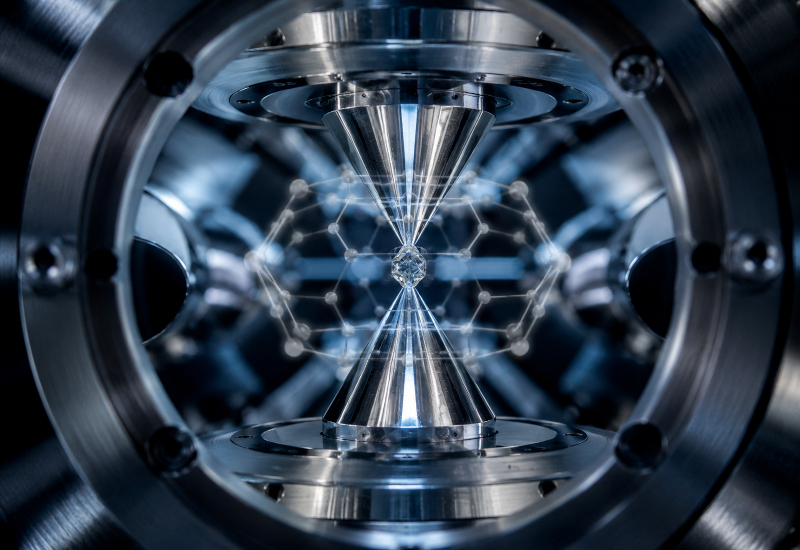
- 100 nanodiamonds were clamped between two cylinders, each with a diamond tip.
- The system was connected to a force sensor and microscope to measure resistance to compression.
- Work was carried out in vacuum to eliminate external influences.
- Modeling
- The obtained data were compared with computer models of the atomic structure of crystals.
Key conclusion
- As size decreases, the proportion of atoms on the surface (shell) increases.
- Connections between the shell and core in nanodiamonds are weaker than in larger stones.
- Therefore small crystals compress more easily: their resistance drops by about 30 % compared with large diamonds.
Why it matters
- Nanomaterials are a key component of future technologies: quantum computers, ultra‑fast sensors, and secure communications.
- Availability: artificial nanodiamonds today cost significantly less, opening new possibilities for their use.
> “Diamonds of ordinary size are known for their exceptional hardness, but at the nanoscale everything changes,” notes lead researcher Chunxin Shan from Zhengzhou University.
> “We have shown that it is precisely the atomic structure of the surface that accounts for the reduction in elasticity.”
Bottom line: The smaller the nanodiamond, the more pronounced the role of surface atoms and the weaker their bonds to the core, leading to a noticeable drop in hardness. This discovery will help optimize the use of nanodiamonds in high‑technology devices.
 Asted Cloud
Comments (0)
Share your thoughts — please be polite and stay on topic.
Log in to comment