
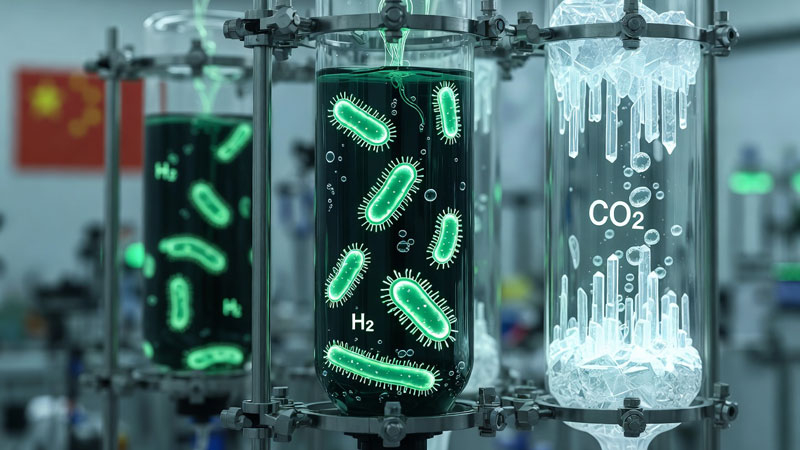
Chinese simultaneously produce hydrogen from waste and sewage while absorbing CO₂.
Chinese team reveals a new method for producing biogenic hydrogen
*Main idea*: fermenting organic waste while simultaneously capturing CO₂ → clean hydrogen and a carbon‑neutral process.
1. What the researchers do – microorganisms convert agricultural, food, and other biofuel wastes in an anaerobic environment (no light or oxygen).
- The result is hydrogen and carbon dioxide.
2. How the CO₂ problem is solved – after primary fermentation, reagents are added that bind the released CO₂, turning it into an insoluble precipitate (calcite).
- This eliminates the need to vent gas and increases overall plant efficiency.
3. Key component – wollastonite – the mineral CaSiO₃ regulates medium acidity, stabilizes bacteria, and promotes CO₂ mineralization.
- At a dosage of 10 g/L:
- Hydrogen production time decreased by ~50 %.
- Specific hydrogen yield increased by about 33 %.
4. Experimental results
| Indicator | Value |
|---|---|
| CO₂ retained in the system | 0.49 ± 0.05 L per L of medium |
| H₂ content in biogas | 58.2 ± 1.1 % |
| Form of captured CO₂ | calcite (stable and suitable for storage) |
5. Why this matters
- Economics: expected payback period – 6–7 years at industrial scale.
- Energy: bioreforming consumes less electricity than water electrolysis and uses cheap feedstock (waste).
- Environment: simultaneously addresses waste disposal and CO₂ emission reduction.
6. Prospective applications
- Agro‑industrial plants and wastewater treatment facilities that generate large volumes of organic material daily.
- Potential to create a “green” energy source on site.
Conclusion: If the technology can be scaled up, it could become a key element of China’s (and other countries’) hydrogen economy, combining waste processing with clean fuel production.
 Asted Cloud
Comments (0)
Share your thoughts — please be polite and stay on topic.
Log in to comment