
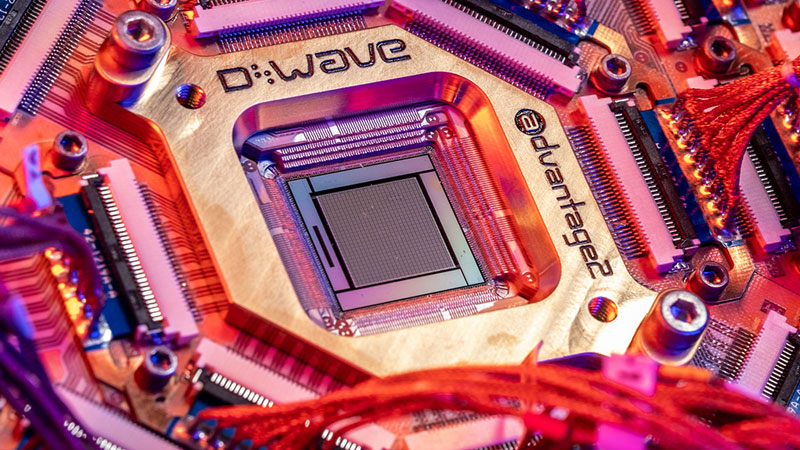
D-Wave promises to build a more advanced universal quantum computer in 2032 that surpasses competitors.
D‑Wave shifts strategy: from specialized quantum annealing to universal gate computers
The company D‑Wave, which has been developing quantum annealing platforms for almost two decades and is close to achieving quantum supremacy in this area, announced a sharp shift in focus. It now plans to move toward building universal quantum computers based on gates (transistors) to quickly catch up with industry leaders – Google, IBM, and others.
Dual‑platform approach
Starting in 2026, D‑Wave will develop two parallel lines:
Direction Current goal Expected outcome
Quantum annealing Commercially available systems for optimization, materials modeling, and AI Continued development of the existing platform
Gate computer Universal computing (quantum chemistry, molecular design, energy storage) Creation of the first reliable universal quantum computer
New architecture – superconducting dual‑rail qubits
For its gate system, D‑Wave chose a dual‑rail scheme. Each qubit is represented by a pair of coupled resonators, allowing:
- Automatic error detection at the qubit level without external correction circuits.
- Reducing the error rate by 90 %, thereby decreasing the number of physical qubits needed for one reliable logical qubit.
Development plan
Year Number of physical qubits Expected error reduction
2026 17 Half as often as a physical qubit
2027 49 20‑fold reduction
2028 18 12000‑fold reduction (prototype fault‑tolerant computer)
2030 10 logical qubits First algorithms with error resilience
2032 100 logical qubits Execution of millions of operations, first fully reliable universal D‑Wave computer
Lambda metric
The company introduces a new metric “lambda” – the rate of error frequency reduction when adding new correction mechanisms. In the industry, a typical value is ~2 (each step halves the error probability). D‑Wave aims to reach λ = 10, meaning a tenfold decrease in error probability at each stage of architectural improvement.
If the company delivers on its promise, it will represent a significant breakthrough: compact and scalable quantum computers with high reliability – a challenge that remains difficult today.
 Asted Cloud
Comments (0)
Share your thoughts — please be polite and stay on topic.
Log in to comment