
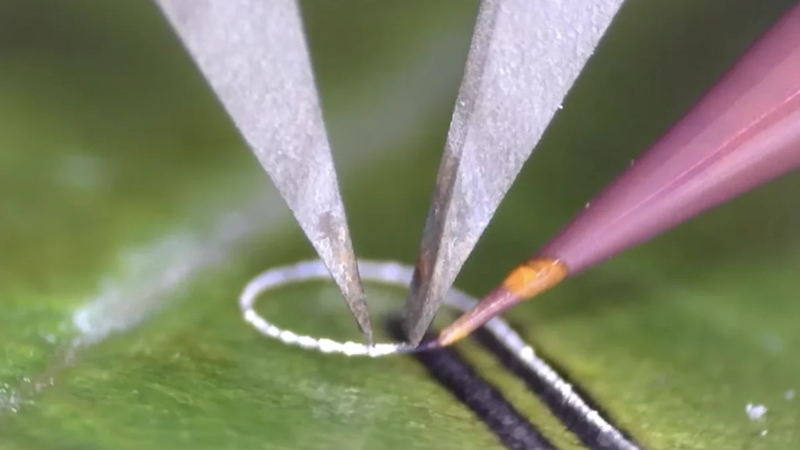
Engineers have created a device that allows electronic components to be applied to living tissues and medical implants without damage
New way to print electronics directly onto living tissues
Engineers from Rice University have created a device that “solders” conductive inks straight onto fabric, bone or surgical implants without damaging their surface. This became possible thanks to the Meta✴‑NFS system – a near-field structure inspired by metamaterials.
How Meta✴‑NFS works
Element | Function
Cutting‑ring resonator | Captures and amplifies microwave energy.
Conical tip | Compresses the amplified wave into a zone less than 200 µm (0.008 inches).
Graphene mediator | Absorbs up to 50 % of the energy, allowing point heating of the material.
As a result, the ink reaches temperatures above 160 °C while the surrounding surface stays cool.
What sets it apart from traditional methods
* Point heating – conventional printing technologies (oven, laser) heat the entire area, destroying tissues and medical materials.
* Light‑soldering requires strict wavelength control, excluding most biological materials.
Meta✴‑NFS uses 79.5 % of microwave power (compared to 8.5 % for standard probes), concentrating energy in a very small volume. This allows changing the crystalline structure of silver nanoparticles “on the fly”, altering their resistivity by more than three orders of magnitude – from nearly conductive to insulating.
Demonstration experiments
Material | What was printed | Result
Living plant leaf | Conductive microstructures | Successfully soldered without damage
Plastic, silicone, paper | Similar structures | Only the target area heated
Bovine bone (femur) | Wireless deformation sensor | Captured small mechanical deviations
Sensor in a silicone sheath remained conductive for over 300 seconds underwater, while unprotected material degraded in 2.5 seconds.
Practical applications
* Orthopedic implants – wireless sensors have already been printed on ultra‑high‑molecular‑weight polyethylene (the material of most artificial hip and knee joints). They monitor wear and stresses in real time without disrupting the implant structure.
* Future directions: swallowable diagnostic devices, direct integration of electronics with organs, robots with built‑in printed electronics.
Project lead’s comment
> “The ability to selectively heat printable materials allows us to define their functional properties at desired points in space even in the presence of thermally sensitive materials,” noted junior professor Yoon Lin Kwon of Rice University’s School of Engineering and Computing Sciences.
> “This opens the way to placing electronics of arbitrary configuration on biopolymers and living tissues using a desktop printer without complex manufacturing conditions or labor‑intensive manual operations.”
Thus, Meta✴‑NFS represents a breakthrough in printed electronics for medical and biological applications, enabling the creation of highly precise, safe, and flexible devices directly on living materials.
 Asted Cloud
Comments (0)
Share your thoughts — please be polite and stay on topic.
Log in to comment