
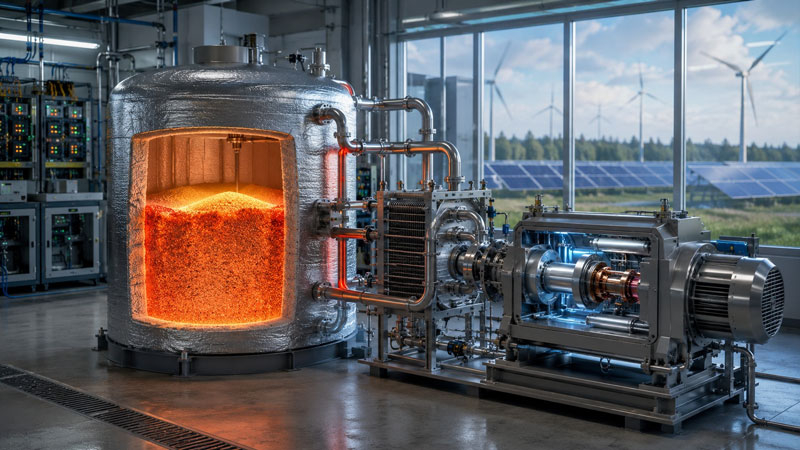
Finnish engineers used a Stirling engine to generate electricity from hot sand
Finnish idea: storing excess electricity in sand
Scientists at Åbo Akademi University (Finland) created and tested for the first time a prototype thermal battery that uses ordinary sand as a heat carrier. Cold heat from solar panels or wind turbines is “memorized” in the sand, and when needed it is converted back into electricity using a free-piston Stirling engine.
What was actually done
Parameter Value
Tank volume 0.2 m³
Sand type brown quartz (grains 0.6–2 mm)
Specific heat capacity 703 J/(kg·K)
Thermal conductivity 0.2–0.7 W/(m·K)
Bulk density ≈1800 kg/m³
The tank was insulated. The sand was heated with an electric heater; after “charging” the heat was transferred to a Stirling engine rated at about 1 kW.
Purpose of the experiment
To compare theoretical calculations with real data in order to assess the prospects of such an energy storage scheme using a cheap heat carrier.
What the tests showed
Temperature Real efficiency (charge‑discharge)
300 °C 4.4 %
350 °C 8.3 %
Modeling a more optimized design predicts:
- 19.1 % at 300 °C,
- 23.2 % at 350 °C,
and even up to 31.6 % when operating up to 500 °C.
Thus, raising the temperature and improving the design could significantly increase the return, but the current prototype is still far from commercial practice.
Main problems
1. Heat losses – a significant portion of energy is lost during storage and transfer.
2. Poor heat conduction – stationary sand does not conduct heat efficiently.
3. Limited efficiency of the “sand accumulator + Stirling engine” combination.
Why the idea is still interesting
- Sand is cheap, widely available, and heat‑resistant; it doesn’t need complex processing.
- Such a battery could become an inexpensive long‑term storage for systems with high shares of renewable energy.
- Unlike already implemented Finnish sand batteries that use heat only for heating or industrial processes, this development aims to return electricity to the grid – a more complex but critically important step for balancing the power system.
Conclusion: the prototype works, but efficiency is still low. With further design improvements and higher operating temperatures, the potential of such a “sand” battery remains high, especially given its simplicity and cost‑effectiveness.
 Asted Cloud
Comments (0)
Share your thoughts — please be polite and stay on topic.
Log in to comment