
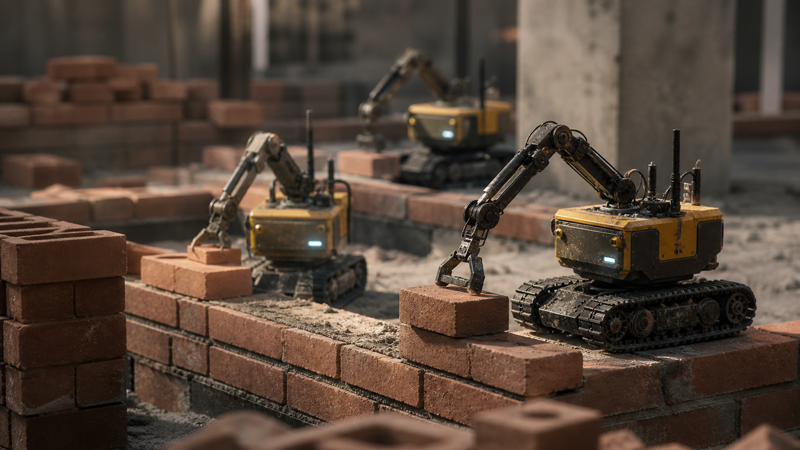
Robotic "ants" have mastered construction and demolition without using advanced artificial intelligence
Brief news
In the near future, the first steps toward exploring other planets will most likely be carried out by robots – from large machines to microscopic devices. The size of such apparatus limits their computational capabilities, but observations of terrestrial insects show that collective behavior can arise without complex AI: simple interaction rules are enough.
New experiment
A group of scientists from Harvard and Madras Institute of Technology (India) created mini-robots called RAnts (“robotized ants”). Researchers note that the name “antdroids” (antroid androids) would be more fitting, but this is not critical. The goal of the project is to study adaptive group behavior of robots without powerful computing systems.
Results
* Self‑organization: a small group of RAnts was able to coordinate actions and build/destroy simple structures without central control.
* Application: such robots could be used for autonomous construction in hazardous places, including space objects.
Interaction mechanism
Coordination is achieved by two adjustable parameters:
1. The strength of interaction between robots.
2. The speed of laying/removing building blocks when a signal threshold is reached.
Robots also leave marks on the surface – photoromones (light signals mimicking chemical pheromones). Around these marks they gather into groups. The more robots concentrate in one place, the more actively they build or destroy.
Collective cognition
As one of the authors explains, robots demonstrate the basics of collective intelligence: not only interaction within the team but also constant reaction to a changing environment. Simple local rules lead to self‑organizing, robust and adaptive execution of complex tasks. Marks in the environment act as cues, engaging the entire surroundings in the control process, which reduces the computational load on the robots and central oversight.
Thus, researchers have shown that even simple autonomous devices can perform effective collective work, opening prospects for future space missions.
 Asted Cloud
Comments (0)
Share your thoughts — please be polite and stay on topic.
Log in to comment