
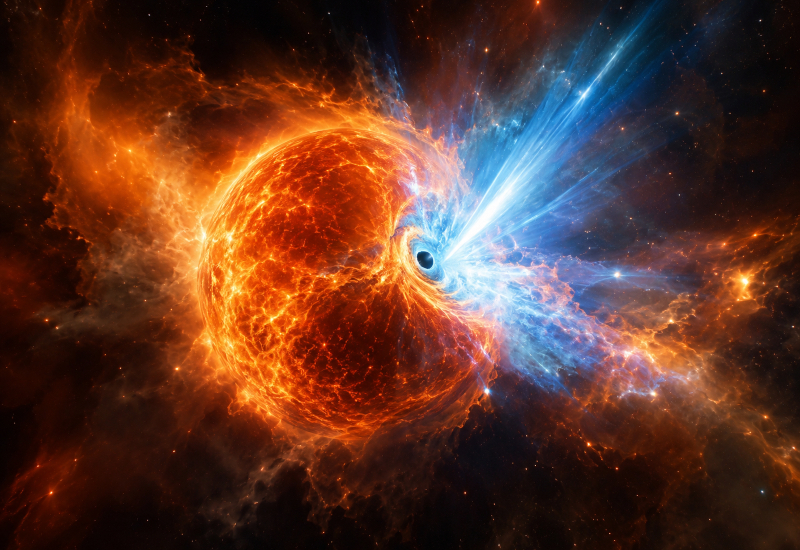
Scientists have found an explanation for the 14 mysterious blue flashes that have been recorded in space since 2018.
New hypothesis on the origin of luminous fast blue optical transients (LFBOT)
Scientists from Harvard Center for Astrophysics have proposed an explanation for how powerful and short-lived bluish flares, known as LFBOTs, can arise in space. Their model links these events to the collapse of a compact star (a black hole or neutron star) that “consumes” a neighboring Wolf–Rayet star—a hot helium core left after a massive star has shed its outer hydrogen envelope.
What is an LFBOT?
- Acronym: *Luminous Fast Blue Optical Transients* – “luminous fast blue optical transients”.
- Short life: peak brightness and subsequent fading occur over just a few days.
- Blue color: the flares remain bluish almost throughout their duration, indicating high temperature.
Since 2018, when the first LFBOT was recorded, astronomers have identified another fourteen similar events. They differ from ordinary supernovae in how quickly they evolve and how “blue” they stay.
Why previous scenarios did not fit?
1. Core-collapse supernovae – assume the explosion of a massive star, but observational data on host galaxies of LFBOTs do not match typical supernova environments.
2. Tidal disruption events (TDE) – events where a black hole tears apart and consumes a star also fail to explain the characteristic surroundings of LFBOTs.
Annie Newjean and her colleagues analyzed the galaxies where flares were observed and concluded: LFBOTs occur in environments distinct from those predicted by supernovae and TDEs.
The “merger” model in a binary system
1. Initial configuration – two massive stars are in close orbital interaction.
2. Cannibalism – one of them (“the cannibal”) gradually strips the outer hydrogen envelope from its neighbor (“the donor”).
3. Result for the donor – after losing its envelope, it is left with an almost entirely helium core, i.e., a Wolf–Rayet star.
4. The cannibal becomes a supernova – having accreted mass, it quickly exhausts fuel and collapses into a black hole or neutron star.
During collapse the system receives a “kick” (lateral thrust) that ejects the pair from dense regions of the galaxy to its outskirts.
How does an LFBOT arise?
- Feeding – after the compact object is formed it feeds the surface of the Wolf–Rayet star for a long time (hundreds–thousands of years), but does not destroy it completely.
- Final catastrophe – when the black hole or neutron star penetrates the dense helium core of the Wolf–Rayet and destroys it, a bright blue flare occurs.
- Duration – the event lasts only a few days.
Why this model is plausible?
1. Rarity of events – such binary systems with the required conditions (not too early merger but sufficient proximity) are rare, which matches the observed frequency of LFBOTs.
2. Flare environment – at the moment of explosion around an LFBOT there is “empty” space, as if the system had been ejected from a dense stellar environment, consistent with the kick effect.
Thus scientists propose that luminous fast blue optical transients arise from the collapse of a compact star that consumes a neighboring Wolf–Rayet star after a long feeding period. This explanation aligns with both the observed characteristics of the flares and their rarity and surroundings.
 Asted Cloud
Comments (0)
Share your thoughts — please be polite and stay on topic.
Log in to comment