
Scientists have united the "clues" about mysterious radio signals from distant corners of space, moving closer to deciphering them
New “Rosetta Stone” – the key to unlocking long‑period radio transients
What are LPTs and why they are mysterious
- Long‑period radio transients (LPT) are rare bursts in radio emission that appear with periods ranging from tens to hundreds of minutes.
- The first report of such a phenomenon dates back four years; since then about 12 sources have been found.
- Each source has had different observations: different frequency ranges, different telescopes – making it almost impossible to combine them into a single classification.
How the new object changed the picture
- In a recent study (Nature Astronomy) astronomers discovered ASKAP J1745−5051 using the Australian radio telescope ASKAP.
- It emits a bright burst every 81 minutes in the radio band, and a similar periodicity is observed in X‑rays (data from Swift and Einstein Probe).
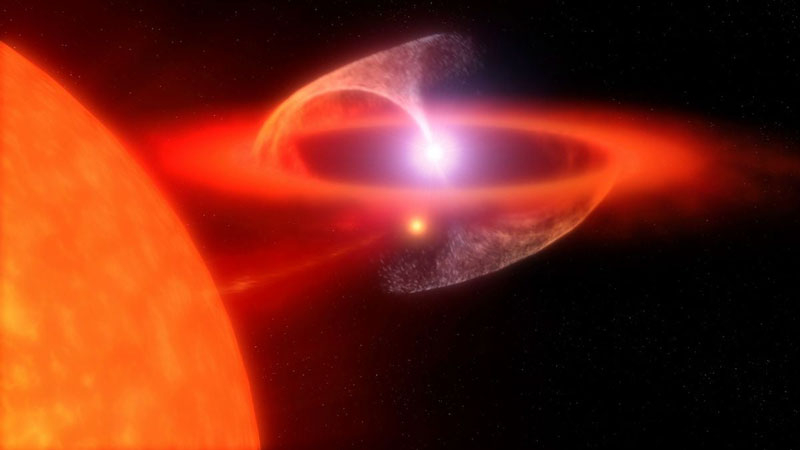
- Optical images (SOAR, Magellan) showed that the source is not a single object but a close binary: a white dwarf + red dwarf.
How the system works
1. The red dwarf transfers material to the white dwarf.
2. The infalling gas heats up to millions of degrees and emits X‑rays.
3. The interaction of the magnetic fields of the two stars with the charged gas likely generates directed radio bursts.
Why it was called the “Rosetta Stone”
- Just as the Rosetta Stone united three languages in one monument, ASKAP J1745−5051 brings together several key features:
- Radio bursts
- X‑ray emission
- Binary system
- White dwarf
- Accretion
- Magnetic activity
- It is the first object where all these elements are present simultaneously.
What this means for science
- Although not every LPT is now explained, the presence of a “Rosetta Stone” provides a benchmark: some long‑period radio transients may occur specifically in magnetic binaries with a white dwarf.
- Searching for similar sets of characteristics in other sources becomes more targeted, speeding up understanding of the nature of these mysterious signals.
Thus, the new object not only expands the known spectrum of LPTs but also paves the way toward a unified theory of their origin.
 Asted Cloud
Comments (0)
Share your thoughts — please be polite and stay on topic.
Log in to comment