
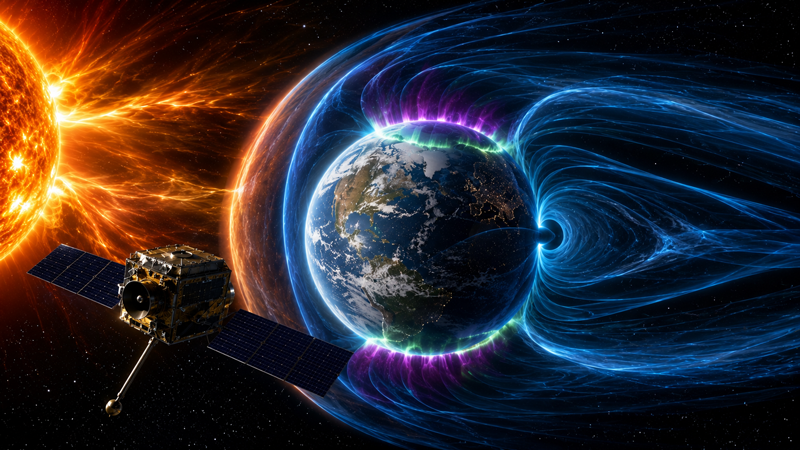
The European‑Chinese observatory has, for the first time, captured the entire Earth’s magnetosphere in space.
Key facts
When/Where How the Vega C19 rocket launch on May 19, 2026, 00:52 local time (06:52 MSK) Seventh launch from Kourou spaceport in French Guiana First target – SMILE satellite – Deployed into a low orbit at ~700 km Orientation of the mission – 11 engine ignitions to transition to an elliptical orbit from 5,000 to 121,000 km above the poles
What is SMILE
SMILE (Solar wind Magnetosphere Ionosphere Link Explorer) is an observatory created jointly by China and the European Space Agency. Its goal is to observe the solar wind and the interaction of Earth's magnetic field with it.
> *“This is the last EU‑China project, after which in 2026 the EU banned funding for joint scientific programs with Chinese scientists.”*
How the satellite will work
1. Solar panel deployment – one hour after launch.
2. Continuous monitoring – at low orbit (~700 km) during the first days.
3. Move to science orbit – 11 engine ignitions to reach an elliptical path from 5,000 to 121,000 km above the poles.
4. “Out‑of‑the‑box” observations – for 40–45 consecutive hours the satellite will look at near‑Earth space from a height of over 100,000 km, recording the sunward side of the magnetosphere and the aurora.
New scientific perspective
Global images of the magnetosphere in the soft X‑ray range – Soft X‑ray Imager (SXI) – main instrument. Developed under the leadership of Loughborough University.
- Maps shock waves, the magnetic pause, and “holes” in polar magnetic fields through X‑ray emission produced when solar wind ions collide with neutral atoms of the exosphere.
Additional ultraviolet sensor – Allows measurement of the same processes in the UV range, enhancing understanding of the interaction between wind, magnetosphere, and ionosphere.
Payload composition
Instrument Mass (kg) Function SXI20 Soft X‑ray detector UVI15 Ultraviolet visualizer of polar auroras LIA10 Light ion analyzer MAG25 Magnetometer
Technical details of SXI
- Energy range: 0.2–2.5 keV
- “lobster eye” optics on microchannel plates with iridium coating
- Field of view: ~15.5° × 26°
- Focal plane: two largest CCD arrays in the world
Project history
*Development began in 2016 as a joint venture between ESA and the Chinese Academy of Sciences.*
Simultaneously with COVID‑19 the project was delayed, but finally completed. After SMILE’s launch the EU announced termination of funding for joint projects with China.
Conclusion
SMILE is the first satellite capable of producing global X‑ray maps of Earth's magnetosphere and observing auroras from space. Its launch opens a new view on the interaction between the solar wind and our planet and marks the end of the era of European‑Chinese space research.
 Asted Cloud
Comments (0)
Share your thoughts — please be polite and stay on topic.
Log in to comment