
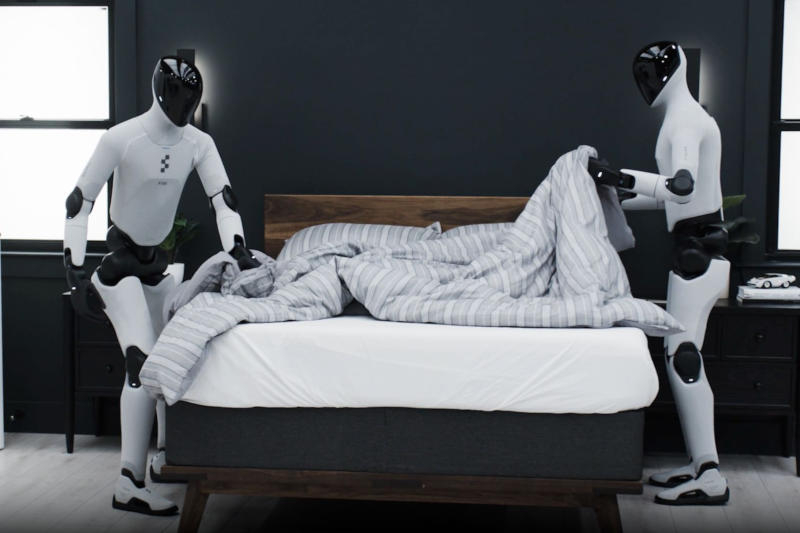
The figure‑robots gathered the room and set up a bed in the video.
Figure demonstrates the synchronous operation of two humanoid robots
The American company Figure showed a video in which its two robots entered a room, gathered scattered items and made the bed—all within less than two minutes.
How did they manage it?
- Coordination without a central controller
The robots do not use a shared scheduler or direct communication channel. Instead, they “communicate” with simple head nods, observing each other through their own cameras and interpreting intentions from the partner’s movements.
- Continuous adaptation
With every action the scene changed: objects moved, the blanket stretched. The machines continuously adjusted grip, pose, and trajectory to achieve the common goal.
A particular challenge – working with a blanket
The blanket has no fixed geometry, so the robots must predict each other’s motions and constantly change their grasp and body position. For this purpose the Helix‑02 model was refined for joint cleaning and folding tasks.
New capabilities of the Helix System AI
- Whole-body control mechanisms
Now the robots use data from side stereo cameras, converting RGB images into real-time 3D models. This allows them to simultaneously “see” and “feel” the surface while moving.
- Improved navigation
As a result, they handle uneven terrain, stairs, and changing lighting better, remaining stable even in challenging conditions.
Training and transfer to reality
The system was trained via reinforcement learning in computer simulation, using a wide set of random landscapes. When transitioning to real-world conditions no additional calibration was required—the architecture already ensured reliable robot operation across various environments.
Thus, Figure demonstrated how two autonomous humanoid robots can effectively coordinate actions without central control, using only visual signals and their own sensors.
 Asted Cloud
Comments (0)
Share your thoughts — please be polite and stay on topic.
Log in to comment