
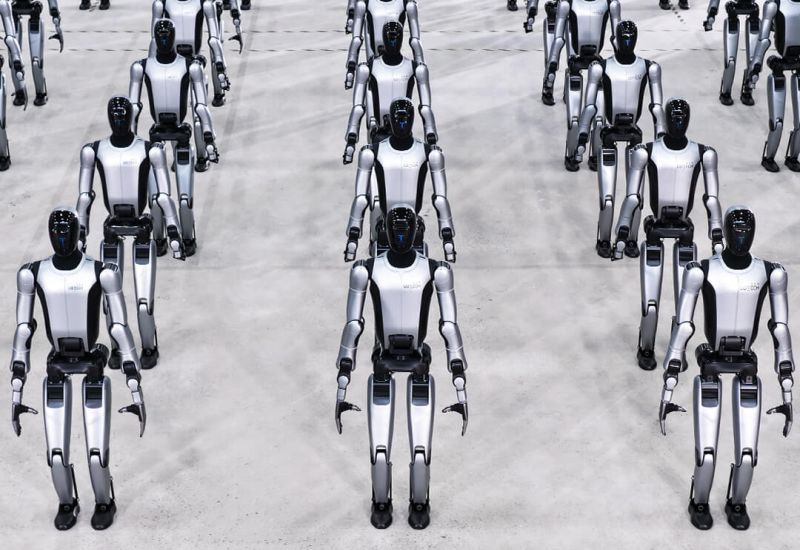
The future “ChatGPT‑moment” for humanoid robots is postponed for the next ten years.
Brief overview of the situation in humanoid robotics
What’s being discussed | Who says it | Key ideas | Time to breakthrough
Van Xiaogan (Daxiao Robotics), Jensen Huang (Nvidia) | A breakthrough could happen in 2‑3 years thanks to scaling data and simulations.
Shao Hao (Vivo) | Expected about a decade until cheap, diverse real data become available.
Current state
Chinese developers: choreography and acrobatics demonstrated at a New Year concert, but movements are “programmed” and performed in a controlled environment.
Remaining problems
All market participants
1) Limited access to large volumes of inexpensive data;
2) Stability and reliability of kinetic systems;
3) Public trust.
Ethical and social issues
Jenny Shipley (former Prime Minister of New Zealand) | People should not expect emotional judgments from robots. Their functions must be regulated, data safety ensured, and accountability managed.
What’s happening now
1. Impact of ChatGPT
The model’s release in 2022 changed the IT market and global economy. It became a “pulse” for further AI development.
2. Forecasts on humanoid robots
- *Van Xiaogan* claims significant progress could be achieved in a couple of years if data volume is increased and world-model simulations are used.
- *Jensen Huang* supports the idea of digital twins as a tool to accelerate learning.
- *Shao Hao* believes a full breakthrough will require about ten years due to lack of real data.
3. 2024 metrics
Chinese robots demonstrated acrobatic and combat skills at a national concert. However, movements were “programmed” based on live choreographer templates, and tests were conducted in static conditions.
Key barriers
Barrier | Why it matters
Low-cost data shortage | Without large volumes of real observations, robots cannot adapt to everyday environments.
Movement reliability | Stability and safety are critical for human interaction.
Public trust | People fear robots making emotional decisions; transparent regulation is required.
How to prepare for mass deployment
1. Safety standards – develop operating and maintenance norms.
2. Social policies – ensure dignified use of freed human resources.
3. Data protection – visual and audio data collection must not threaten cybersecurity.
Regulatory example
Singapore has already proposed framework rules for AI agents that could serve as a model for robotics. Jenny Shipley emphasizes the importance of clear governance structure and responsibility distribution: “I don’t know who’s in the driver’s seat right now.” This underscores the need for transparency in management and regulation of new technologies.
Conclusion:
ChatGPT’s release confirmed the huge potential of AI. In humanoid robotics, forecasts range from 2 to 10 years until a real breakthrough. Current demonstrations are impressive, but practical application requires large-scale data, movement reliability, and public trust—achievable only through safety standards and transparent regulation.
 Asted Cloud
Comments (0)
Share your thoughts — please be polite and stay on topic.
Log in to comment