
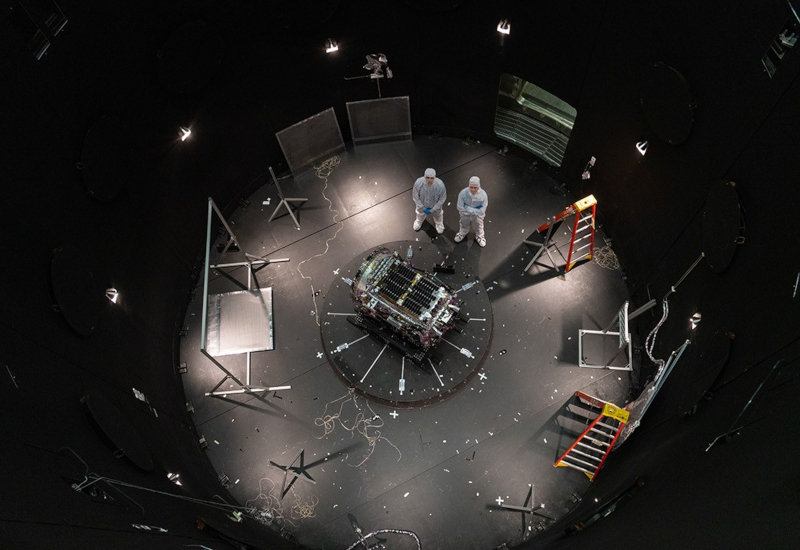
The LINK-satellite completed its trials, accelerating the rescue of the Swift Observatory from atmospheric destruction
Link service device designed for capturing and rescuing the Neil Gehrels Swift Observatory satellite passed all required tests at the Goddard Space Flight Center. It is planned to be installed on a Pegasus (Northrop Grumman) rocket in early June 2026, with the launch itself scheduled for the second half of the month.
What was done before launch
Stage Description
Vibration testing Simulation of launch shake.
Thermo‑vacuum chamber Test under space vacuum and extreme temperatures.
Ion engines Burn tests of three xenon thrusters.
Robotic arm Deployment of one of the device’s three manipulators.
The launch will be conducted from the Stargazer (L‑1011 TriStar) aircraft. The Pegasus rocket will take off in the air at an altitude of about 12 km.
Compressed preparation timeline
* August 2025 – NASA requested proposals from U.S. companies for Swift rescue.
* Shortly thereafter – Katalyst Space Technologies received a contract and began work.
* February 2026 – NASA suspended most on‑board scientific operations to slow the orbit decay and give extra time for the rescue mission.
Comments from leaders
> “We found ourselves in an unusual situation: the schedule dictates the risk level, not the other way around,” explained Kiran Wilson, lead LINK researcher at Katalyst.
> “Time is ticking: Swift keeps descending, and we have to balance testing with problem solving to give the mission the best chance of success.”
Mission director John Van Epul noted:
* If the observatory isn’t raised to a higher orbit, it could enter the atmosphere by the end of 2026.
* Swift has been operating for more than 20 years, although initially two years of gamma‑ray burst observations were planned.
* Without lowering its orbit and attempts by Donald Trump’s administration to eliminate the mission from the 2026 fiscal year budget, the observatory could have continued working for many more years.
Conclusion: The Katalyst Space Technologies team is operating in a “race against time” mode to complete all tests and launch LINK by early June 2026, thereby saving one of NASA’s most valuable scientific instruments.
 Asted Cloud
Comments (0)
Share your thoughts — please be polite and stay on topic.
Log in to comment