
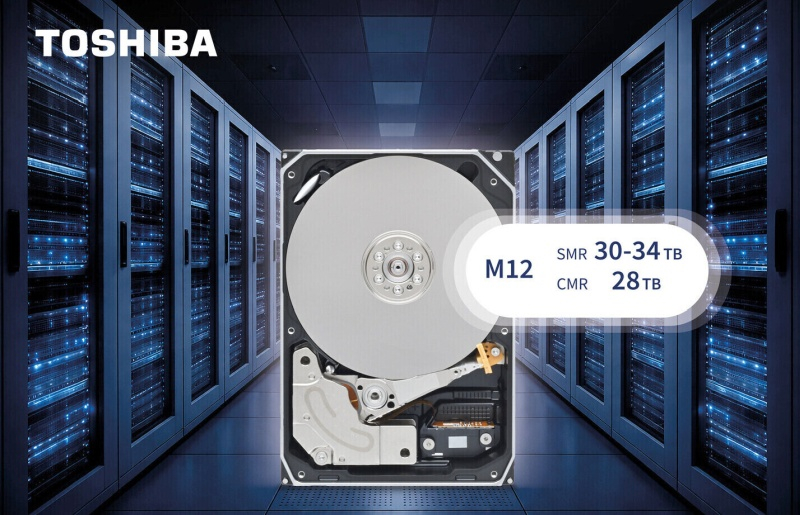
Toshiba has begun shipping 3.5-inch HDDs with SMR and capacities ranging from 30 to 34 terabytes.
Toshiba announced a new line of 3.5‑inch HDDs M12
The company unveiled a series of M12 hard drives designed for hyperscalers and cloud providers operating in large data centers. The drives use *shingled magnetic recording* (SMR) technology and offer capacities from 30 to 34 TB. In the third quarter of 2026, versions with conventional magnetic recording (CMR) will become available, with a capacity up to 28 TB.
What is near‑line storage?
Near‑line is a compromise between:
- Online storage: fast and frequent data access.
- Offline/archive storage: backup, long‑term storage with infrequent access.
Why it’s important to upgrade HDDs now
* World Backup Day reminds us of the critical role of data protection.
* Growing digital services, video content, cloud solutions, and AI generate massive streams of information that require ever larger drives.
Technical features of M12
Feature Description
Platters 11 (one more than MG11/MA11)
Media material Glass – increases durability and allows a thinner enclosure
Enclosure Filled with helium
Recording Flux Control Microwave‑Assisted Magnetic Recording (FC‑MAMR) + SMR
Density 30–34 TB thanks to track overlap (SMR)
How the SMR performance drop is addressed
Toshiba implemented an optimized data placement and rewrite management system that reduces speed loss during random write operations.
Performance and reliability
* Max speed: 294 MB/s (≈ +8 % over the previous generation).
* Power consumption: ~18 % lower per TB.
* Reliability: MTTF/MTBF = 2.5 million hours; AFR ≤ 0.35 %.
* Annual load: up to 550 TB.
* Operating time: 24/7.
Future plans
Toshiba intends to increase drive capacities even further by adopting next‑generation technologies:
- Heat‑assisted magnetic recording (HAMR);
- Increasing the number of platters to 12.
Thus, the M12 series becomes a key component of large data center infrastructure, providing high storage density and reliable operation under intensive workloads.
 Asted Cloud
Comments (0)
Share your thoughts — please be polite and stay on topic.
Log in to comment