
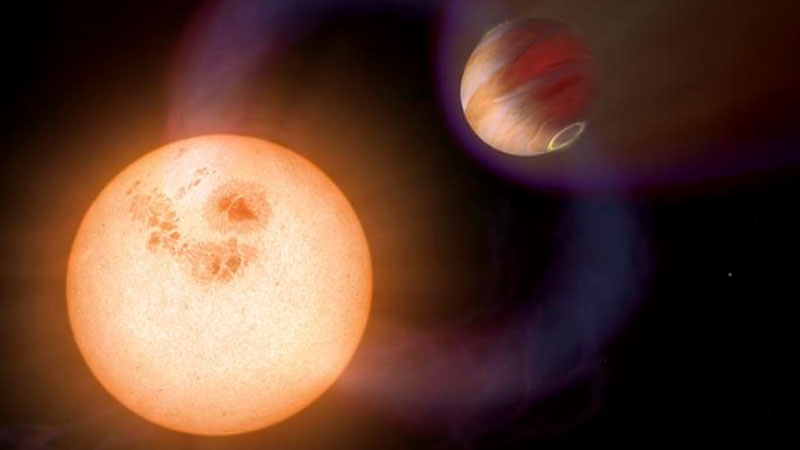
AI discovered new exoplanets hidden in archival data from the TESS telescope
New exoplanets discovered with the AI “Raven”
Scientists from the University of Warwick have created and tested an artificial intelligence called RAVEN (“Raven”) for finding planets outside the Solar System in data from the TESS space telescope. The telescope monitors millions of stars, recording small changes in their brightness that may signal a planet passing in front of its star.
What RAVEN does
* A full analysis cycle – from initial detection of a signal to its statistical verification.
* Trained on a massive set of simulated data, allowing it to distinguish real planetary signals from false positives (binary stars, instrument noise).
* With this approach more than 2,000 exoplanet candidates have been identified, almost half of which were previously unknown.
Key results
Metric Value Processed stars Confirmed planets >100 (31 new)
* More than 2.2 million >100 (31 – new)
Special attention is drawn to:
* Ultra‑short‑period planets – orbits less than a day.
* “Desert hot Neptunes” – rare mass, almost never seen in this range.
* Systems with several closely spaced planets.
These discoveries expand our understanding of the diversity and formation of planetary systems.
Distribution statistics
* Close‑by planets: about 9–10 % of Sun‑like stars.
* Desert hot Neptunes: found around approximately 0.08 % of stars.
The results confirm the effectiveness of combining big data and AI to accelerate astronomical discoveries and open new prospects for studying the Universe.
 Asted Cloud
Comments (0)
Share your thoughts — please be polite and stay on topic.
Log in to comment