
American scientists have developed a memory that operates up to 700 °C—suitable for Venus, nuclear reactors, and artificial intelligence
New type of memory capable of operating at 700 °C – a USC discovery
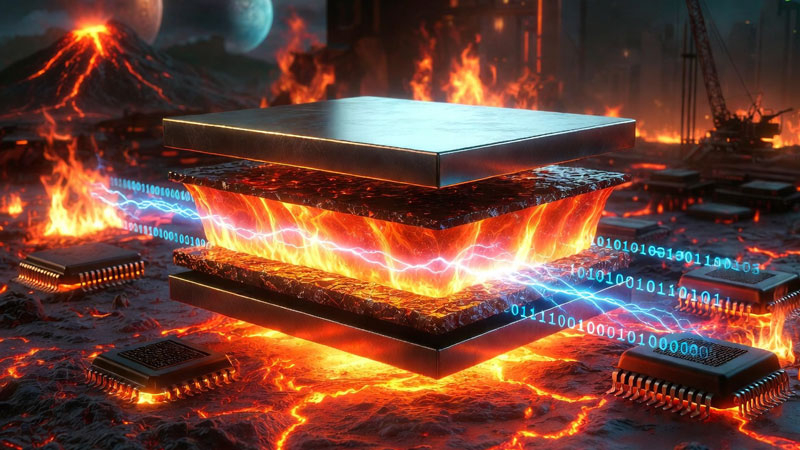
Scientists from the University of Southern California (USC) have created a memristor that can function in extreme temperatures up to 700 °C—almost 500 °C higher than what standard electronic components allow. Conventional electronics already fail at 200 °C, whereas this element remained operational even at lava’s melting point.
How it works
- Design – a “sandwich” of three layers:
1. Tungsten (top electrode)
2. Hafnium oxide (ceramic interlayer)
3. Graphene (bottom layer)
- The key role of graphene is that its uniform atomic layer protects the tungsten from bonding to the ceramic, preventing short circuits and device degradation. This can be compared to a hydrophobic effect: “water does not stick to oil.”
Tests and specifications
Parameter Value
Testing temperature up to 700 °C (verified at equipment limit)
Data retention time without refresh > 50 hours
Switching cycles more than 1 billion
Operating voltage 1.5 V
Operation speed tens of nanoseconds
These data are confirmed by electron microscopy, spectroscopy, and quantum models.
Why it matters
- Applications: Venus (where temperatures exceed 400 °C), geothermal plants, nuclear reactors, automotive electronics—any field where standard components cannot survive.
- AI and matrix computing: The memristor can perform direct matrix multiplication according to Ohm’s law, significantly saving energy and speeding up calculations compared to traditional processors.
Future
Although a full “computer” that operates at high temperatures is not yet available (logic and other elements are needed), having reliable memory already solves a key problem. Scientists have founded the startup TetraMem, which plans to integrate memristors into AI chips for room‑temperature operation, expanding matrix computing capabilities.
Thus, the USC discovery opens new horizons for high‑temperature systems and makes possible technologies that were previously considered impossible.
 Asted Cloud
Comments (0)
Share your thoughts — please be polite and stay on topic.
Log in to comment