
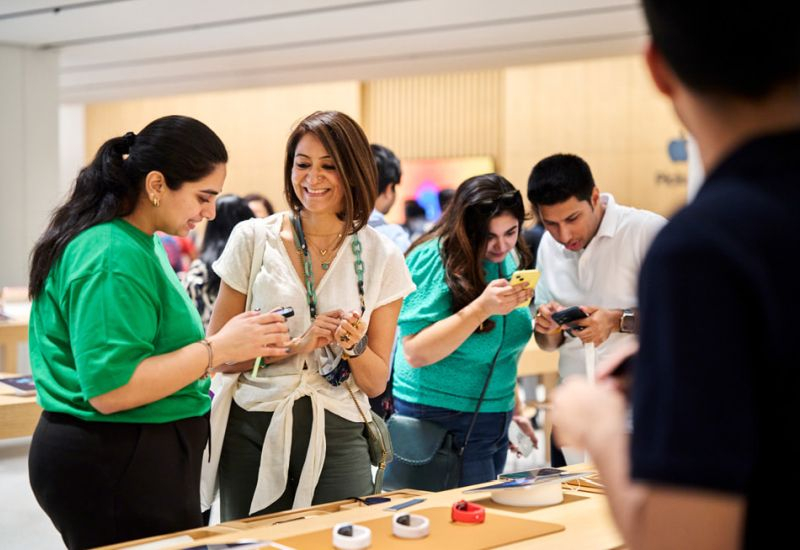
Apple increased iPhone shipments in a declining smartphone market, taking leading positions.
Brief summary
- In the first quarter of 2024 the global smartphone market shrank by 6%, mainly due to a shortage of memory chips and their price increase.
- Despite this, Apple became the only company that increased shipments and market share: volumes grew by 5% YoY, and market share rose from 19% to 21%.
- Otherwise, market leaders (Samsung, Xiaomi, Oppo, Vivo) lost shares and/or shipment volumes, while “peripheral” brands (Google, Nothing) were able to increase sales.
1. Why Apple became the exception
Factor How it helped Apple Access to memory The scale of business and relationships with suppliers allow obtaining chips on priority terms. Price segment The product is in the upper price range where demand is less sensitive to component cost increases. Demand for iPhone 17 Popularity of the new lineup and active trade‑in programs stimulated sales. Geography Sales grew faster in China, India and Japan than in most other regions.
2. Overall market dynamics
- Memory shortage forced manufacturers to rethink pricing policy, assortment and announcement schedules.
- Macroeconomic uncertainty (conflict in the Middle East) intensified the drop in demand.
- Some companies tried to “fill” the market before logistics worsened, but overall supply decline remained around 6%.
3. Top‑5 positions
Company Market share (2023 → 2024) Change in shipment volumes Apple 19 % → 21 % +5 % YoY Samsung 20 % (unchanged) –6 % Xiaomi 14 % → 12 % –19 % Oppo 11 % → 8 % –4 % Vivo 7 % → 11 % –2 %
- Samsung retained its share but cut shipments of mass models; the flagship Galaxy S26‑Ultra remained in demand.
- Xiaomi lost almost a third of volumes due to dependence on price‑sensitive segments. The premium model 17 still sells well in China.
- Oppo and Vivo swapped places, but both remain in the top five; Vivo even increased its market share thanks to a strong position in India.
4. Market outside the quintet
- Overall weight: ~28 % (loss of one percentage point).
- Decline in shipments: –10 %.
- Leaders:
- Google +14 % volumes.
- Nothing +25 %, thanks to an innovative feature set and unusual design.
5. Forecast for 2026
Counterpoint Research expects the memory shortage to remain moderate, and the smartphone market will continue to face pressure:
- Volume decline will be slower but still noticeable.
- Companies that can quickly adapt their assortment and strengthen supply chains (especially those already working with their own chips) will have an advantage.
Conclusion
Under limited memory and rising prices Apple was able not only to hold its positions but also to expand them. Other major players faced falling demand and shipments, while peripheral brands showed that innovation and unique design can offset economic difficulties. By 2026 the trends are expected to continue, but without sharp swings.
 Asted Cloud
Comments (0)
Share your thoughts — please be polite and stay on topic.
Log in to comment