
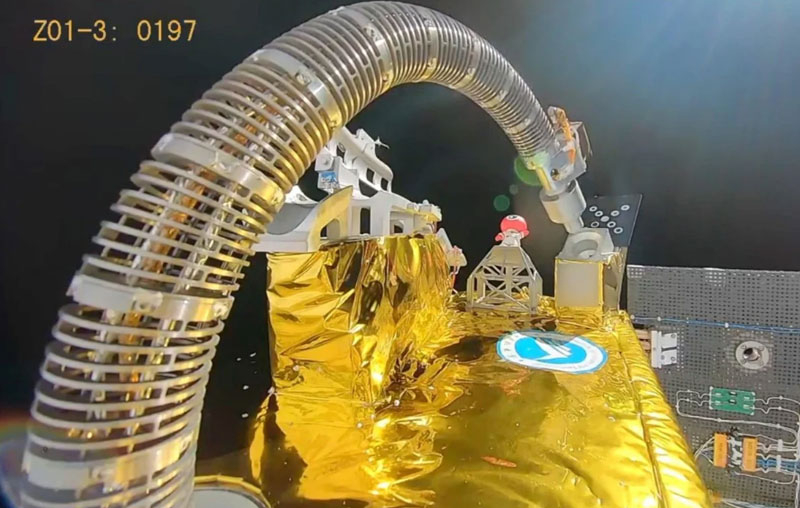
China successfully conducted an orbital launch of a space refueling vehicle: the "booster" satellite paved the way for new space fueling technology
Chinese commercial refueling satellite passes successful test
Parameter Value
Satellite name Hukeda‑2 (Hukeda‑2)
Mission Test refueling on low Earth orbit
Orbital altitude 530–540 km, sun‑synchronous
Orbit speed ~27 000 km/h
Launch date Last week (from Jiuchuan cosmodrome)
What was done
1. Approach and refueling simulation
The refueling satellite successfully approached the target spacecraft using a flexible robotic manipulator – the “tentacle,” resembling an octopus arm. It can bend, twist, and grasp objects in confined space.
2. Tentacle technology
- Consists of connected spring‑like segments controlled by motors and cables.
- At the end is a nozzle‑tip designed to enter the satellite’s refueling port.
3. Success in orbit
Developers compared the maneuver to “threading a needle in space,” emphasizing the difficulty at 27 000 km/h and extreme temperature swings.
What next
- Inflatable device test
Hukeda‑2 plans to test a 2.5‑m diameter sphere that will increase atmospheric drag on the satellite. This will allow rapid, controlled orbital decay, helping combat space debris.
- Full service
The satellite demonstrates not only refueling but also waste management: a combined approach to servicing and disposal.
Why it matters
1. Commercial project without state company involvement
Created jointly by Hunan University of Science and Technology and Suzhou Sanyuan Aerospace Technology – the first such Chinese commercial launch.
2. Expanding orbital servicing capabilities
The test confirms the technology’s readiness for real-world use, paving the way for future “space refueling stations.”
3. Extending satellite lifespan and reducing debris
Successful trials allow longer operation of costly spacecraft and reduce the number of active objects in Earth orbit.
Context
Hukeda‑2 continues a series of Chinese orbital servicing experiments, including last year’s Shijian‑25 on geostationary orbit. The commercial nature of the project highlights the growing role of private companies in China’s space program and lays the groundwork for sustainable space exploration in the future.
 Asted Cloud
Comments (0)
Share your thoughts — please be polite and stay on topic.
Log in to comment