
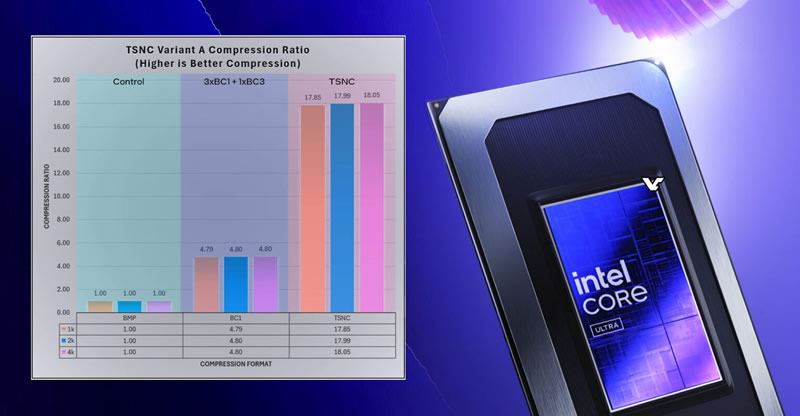
Intel tested neural texture compression on Panther Lake, shrinking packet sizes by a factor of 18.
Intel Unveils Ready-Made SDK for Neural Texture Compression
Intel announced the release of a full-featured toolkit (SDK) for TSNC — Texture Set Neural Compression. Previously it was presented as a research demo; now it can be used in commercial products.
What Changed
- The new SDK enables integration of TSNC into any game engine or application.
- Texture packs are expected to shrink by up to 18×, significantly saving user disk space.
How It Works
TSNC trains a neural network to encode and decode an entire set of textures simultaneously, bypassing the limits of traditional block compression. Two modes are offered:
| Mode | Compression Level | Quality Loss |
|---|---|---|
| A | ~9× smaller | 5 % (changes almost invisible) |
| B | ~18× smaller | 6–7 % (visible artifacts, especially in normal maps) |
The choice depends on whether preserving image quality or achieving maximum size reduction is more important.
Performance
- The TSNC decoder supports two computation paths:
- Basic FMA path (compatible with all CPUs and GPUs).
- Fast linear algebra path using XMX acceleration on compatible Intel graphics chips.
- On integrated graphics B390 (Panther Lake processors), the linear algorithm processed at 0.194 ns/pixel, roughly 3.4× faster than the basic method.
Use Cases
The technology can be applied:
- During initial game installation.
- While loading levels.
- In background streaming mode.
- For per-pixel data sampling in real time.
The scenario chosen depends on what needs optimization: video memory usage, bus load, or overall game weight.
Release Plans
| Stage | Date |
|-------|------|
| Alpha SDK | End of this year |
| Beta testing | After alpha |
| Public release | Planned soon |
A new data unpacking API will be available for C, C++, and HLSL.
Industry Context
Intel is not the only company developing neural texture compression. Nvidia previously showcased its solutions at GTC 2026, confirming growing interest in such technologies within the gaming industry.
 Asted Cloud
Comments (0)
Share your thoughts — please be polite and stay on topic.
Log in to comment