
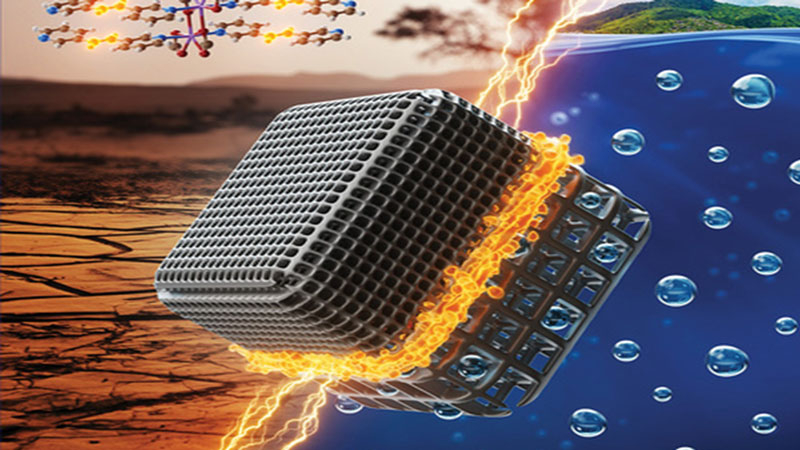
Material has been created for an “infinite flask” that extracts moisture from the air under sunlight.
New way to harvest water from air: sun‑activated MOF
Chemists at the University of Iowa discovered an unusual method for extracting moisture from the atmosphere that does not require energy input for the process itself. Instead of traditional porous absorbents, they created a crystalline structure activated by sunlight and sensitive to ultraviolet (UV) light. This “endless flask” can collect water from air without external energy costs.
What is a MOF?
We’re talking about metal‑organic frameworks (MOFs)—materials in which metal atoms form the vertices of a lattice, connected between them by organic molecules. When the metal bonds break, organics are inserted in their place, creating huge internal voids. These “bags” can be tuned to the desired molecular size: they hold only those substances that physically fit inside. Because of this, MOFs are used for capturing CO₂, toxic gases, and even useful compounds.
How the new material works
Iowa scientists added a special UV‑responsive reaction to a standard MOF:
1. In darkness – the lattice of molecules is dense, with no cavities for water.
2. After UV irradiation – the structure changes configuration, opening microscopic caverns.
3. X‑ray diffraction analysis showed the presence of water molecules in these new voids.
Thus, the material “activates” under sunlight: until illuminated it remains dry; when exposed to light pores open and water is absorbed.
Laboratory experiment results
- Humidity – in laboratory conditions the MOF retained about 5 % of its own mass as water.
- Comparison with top systems – currently less than some existing MOF‑based water‑harvesting systems, but this merely confirms the working principle.
Prospects
This experiment demonstrates the possibility of creating “smart” sorbents that do not just passively absorb moisture but are activated by sunlight. It opens a path for further development of the material and increasing its efficiency for practical use in energy‑constrained environments.
 Asted Cloud
Comments (0)
Share your thoughts — please be polite and stay on topic.
Log in to comment