
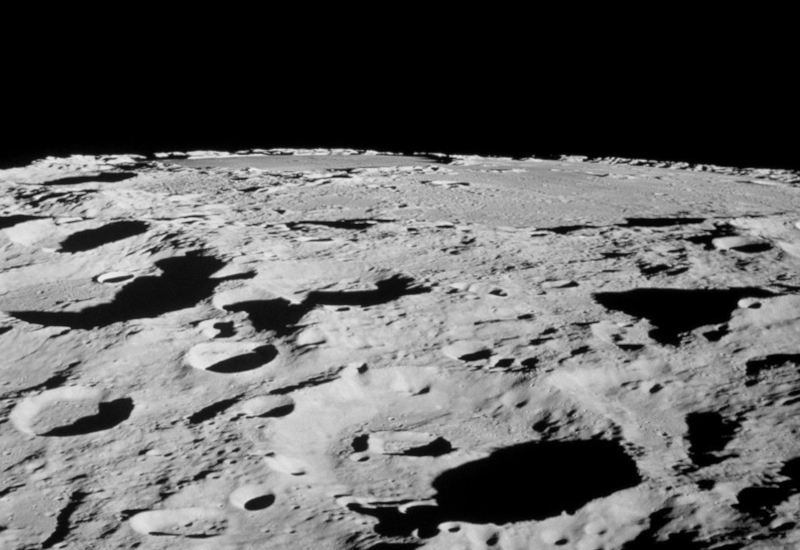
Minus 223 °C and eternal darkness: scientists propose installing a laser GPS on the Moon directly in craters
New Approach to Lunar Navigation: Lasers in Permanently Shadowed Craters
Scientists from the National Institute of Standards and Technology (NIST) have proposed placing ultra‑stable laser sources in permanently dark craters at the Moon’s south pole. Their goal is to create a “lunar GPS” that will allow astronauts, rovers, and spacecraft to navigate without ground station assistance.
Why shadowed craters?
* Extreme cold – temperatures in these depressions drop to −223 °C, even lower than Pluto’s surface.
* Ultra‑high vacuum and lack of vibrations – natural conditions that provide resonator stability without the need for cryogenic cooling or complex vibration isolation.
* Permanent darkness – due to the Moon’s small axial tilt, craters remain perpetually shaded, making them an ideal environment for high‑precision lasers.
Technology
The core is a silicon optical resonator: a beam repeatedly reflects between two mirrors spaced at a fixed distance. This provides an almost constant emission frequency and makes the laser a reliable chronometer.
> “As soon as I realized that shadowed regions could offer such stability, I saw them as the perfect environment for an ultra‑stable laser,” says lead author Jun Ye (Zhu Yun).
How it will aid navigation
* The lunar GPS will rely on reference time signals transmitted from the craters.
* Satellites and communication networks can use these signals in combination with atomic clocks to determine precise positions.
* This is especially important at the south pole, where complex lighting conditions hinder traditional navigation.
Context
The idea of ultra‑stable lasers complements existing NASA proposals for a lunar navigation system: satellite assistants, radio beacons, and atomic clocks. The new study opens the possibility of using natural lunar features as a “natural” cooling and stabilizing element.
Results were published on May 8 in *Proceedings of the National Academy of Sciences* and could represent a key step toward autonomous lunar navigation needed for long‑term Artemis missions.
 Asted Cloud
Comments (0)
Share your thoughts — please be polite and stay on topic.
Log in to comment