
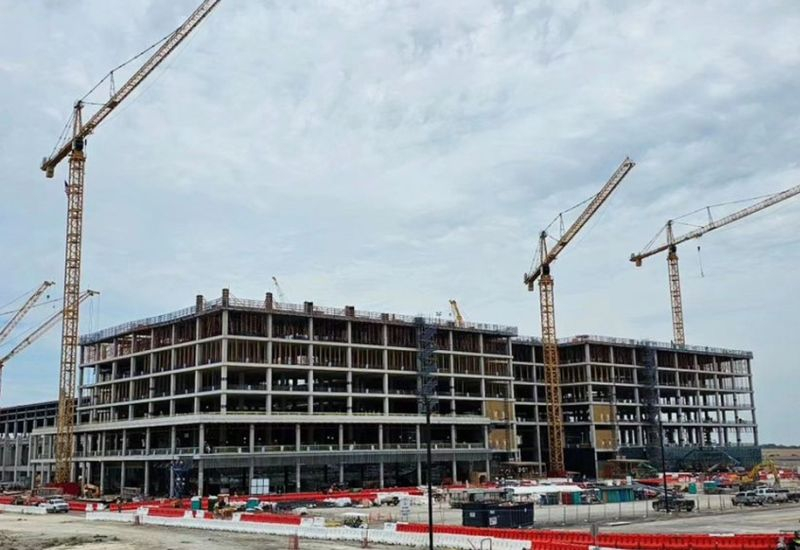
Samsung plans to open a second factory in Texas for the production of high‑technology microchips
Short overview of how Samsung is pushing the boundaries of chip manufacturing in the United States
When Key Components New Advanced Factory (Fab 1) Taylor, Texas Launch by 2027 Contract chip production on the most advanced process nodes; clients – Tesla, possibly Nvidia. Own project in Texas Taylor Construction since 2022; timelines still to be finalized Samsung has already applied for approval of Fab 2 (another site of the same size). On a ~513‑acre parcel up to 10 similar facilities could be accommodated. Contract sales – In Q3 2024 Revenue from contracts rose by 6.7% to $3.4 billion; market share – from 6.8% to 7.1%. Key order – Long‑term contract with Tesla for $16.5 billion: production of chips for Tesla AI platform AI5. Production is expected to start in mid‑next year.
What’s happening now
1. U.S. and TSMC
The Trump administration actively supported TSMC’s expansion in Arizona but did not exert significant pressure on Samsung.
2. Samsung in Texas
- In the 1990s the company already had a chip cluster with “old” lithography.
- For modern production it chose a new site in Taylor, where Fab 1 – a contract plant for advanced process nodes – is planned.
- Rumors say Samsung has already attracted 121 potential customers for this facility.
3. Fab 2 and future plans
- Samsung applied for approval to build a second site (Fab 2) in Taylor.
- On the allocated ~513‑acre plot up to 10 plants could be built; implementation timelines are still undefined.
4. Regulatory steps
In February Samsung received permission for a partial launch of Fab 1 production, and further construction awaits all necessary approvals from contractors.
5. Financial results and contracts
- Revenue from contract activities rose to $3.4 billion (6.7% growth).
- Samsung’s share of the global contract services market increased from 6.8% to 7.1%.
- A long‑term contract with Tesla for $16.5 billion was signed – AI platform chip production is set to begin mid‑next year.
Why this matters
- Competitive advantage: Samsung plans to produce 2‑nm chips in the U.S., giving it a temporary edge over TSMC until the Taiwanese company can overcome regulatory constraints.
- Strengthening its position in the contract services market: Growth in revenue and market share confirms a successful strategy of expanding production beyond Taiwan.
Thus, Samsung is actively building infrastructure for advanced chip manufacturing in the United States, bolstering its positions both as a technology supplier and as a key partner to major tech giants.
 Asted Cloud
Comments (0)
Share your thoughts — please be polite and stay on topic.
Log in to comment