
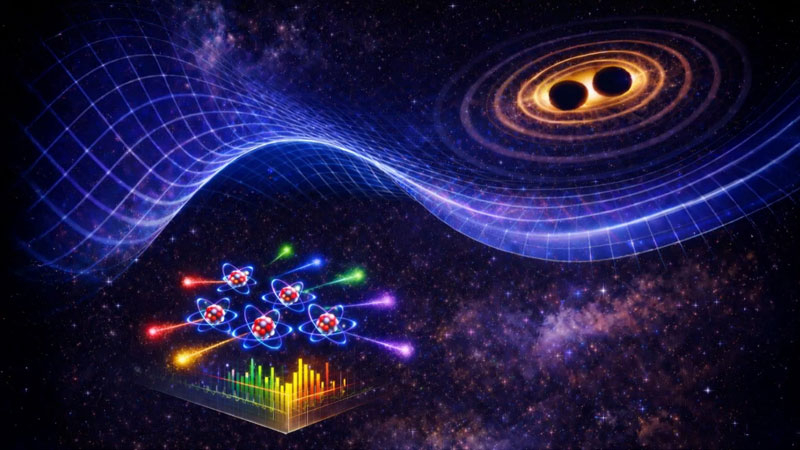
Scientists have discovered an astonishingly simple method for detecting gravitational waves that is almost unbelievable
New Approach to Detecting Gravitational Waves
Scientists from Stockholm University, Nordita and the University of Tübingen have proposed a completely different way to detect gravitational waves. Instead of measuring wavelength fluctuations of light in kilometer‑scale interferometers, they plan to register changes in photon color emitted by atoms.
Why It Matters
* Current detectors
LIGO, Virgo and KAGRA use mirrors with arms about three kilometres long. This makes them sensitive to high‑frequency waves produced during collisions of small black holes and neutron stars.
* Low‑frequency events
Mergers of supermassive black holes generate gravitational waves with periods up to several years. Detecting them requires mirrors separated by hundreds of thousands of kilometres – only possible in space (plans for the end of 2030).
* Compact alternative
Swiss scientists have developed a theory that allows portable detectors for such events. This would greatly simplify and speed up their construction.
How the New Idea Works
1. Modulation of the quantum field – passing gravitational waves slightly alter the phase of the electromagnetic field around atoms.
2. Spontaneous emission – atoms absorb energy, go to excited states and later return to the ground state, emitting photons.
3. Frequency shift of photons – modulation causes a small shift in the frequency (color) of emitted photons. This shift depends on the direction of photon propagation.
So far these effects have not been observed because gravitational waves do not affect the intensity of spontaneous emission; brightness remains unchanged. However, spectral characteristics of light change depending on the strength and direction of the waves – this has already been theoretically confirmed.
Technological Implementation
* Atomic clocks – new detectors will use ultra‑stable atomic clocks based on ultracold atoms.
* Event duration – such clocks can track processes lasting up to several years, which is ideal for observing supermassive black hole mergers.
* Advantages – compactness and faster deployment compared with gigantic space laser interferometers.
Next Steps
Scientists emphasize the need for careful noise analysis, but initial estimates look promising. If the theory holds, compact instruments will emerge that open a new class of gravitational waves previously inaccessible to observation.
 Asted Cloud
Comments (0)
Share your thoughts — please be polite and stay on topic.
Log in to comment