
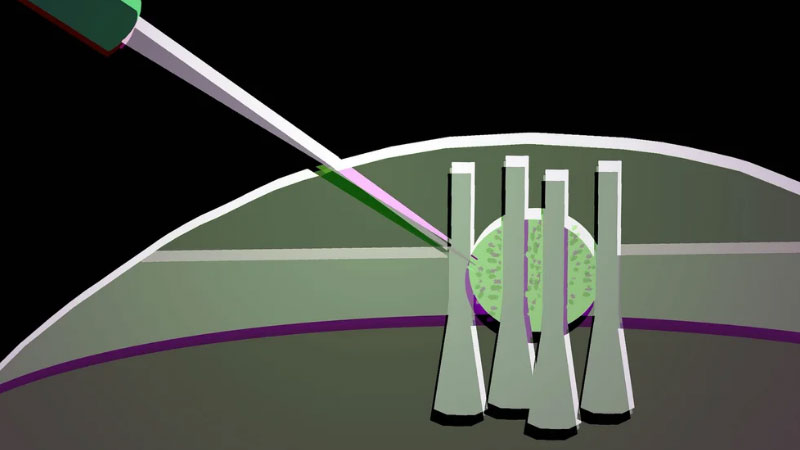
Scientists turned a drop of liquid crystal into a flexible optical transistor for future photonic chips
New “soft” photonics: liquid crystals + polymers open the way to energy‑efficient chips
Traditional optical electronics use the same materials as silicon microcircuits. This leads to typical solid‑state device limitations—high power consumption, complex manufacturing techniques, and limited flexibility.
Recent research from Ljubljana University (Slovenia) has shown how to bypass these problems by creating an “optical transistor” based on a droplet of liquid crystal placed in a polymer waveguide.
How it works
1. Device fabrication
- A pipette introduces a liquid drop into a frame of flexible optical waveguides (polymer).
- Inside the drop is a fluorescent dye that reacts to light.
2. Exciting WGM resonance
- A low‑power laser pulse excites in the drop a so‑called *WGM resonance* (whispering‑gallery mode).
- Photons “stick” inside the drop, repeatedly reflecting off its walls. This allows light to be confined at an energy two orders of magnitude lower than in silicon photonics.
3. Optical amplification and switching
- A second pulse of a different color (different wavelength) and low power initiates the amplification process: resonant photons give up additional energy.
- As a result, an “optical switch” emits light with a delay determined by the timing of the second pulse.
Thus, the control signal has extremely low power but can fully govern the output optical flow—something impossible in traditional silicon systems.
Why it matters
Benefits:
- Reduced power consumption – more than 100‑fold less energy compared to existing photonic technologies.
- Ease of fabrication – a drop can be introduced in fractions of a second, without complex steps and at low temperatures.
- Design flexibility – polymer waveguides enable flexible and unconventional geometries unavailable for silicon.
- Expanded design possibilities – the ability to integrate various cavities and complex optical circuits into one device.
Prospects
Although current technology still cannot match silicon neural networks, it lays the foundation for:
- fully optical logic gates,
- photonic processors,
- future neural networks.
In the long term, this opens the path to ultra‑fast and ultra‑economical computing systems with minimal energy loss.
Soft photonics promises a revolution in optical technology by combining ease of manufacturing, material flexibility, and high performance.
 Asted Cloud
Comments (0)
Share your thoughts — please be polite and stay on topic.
Log in to comment