
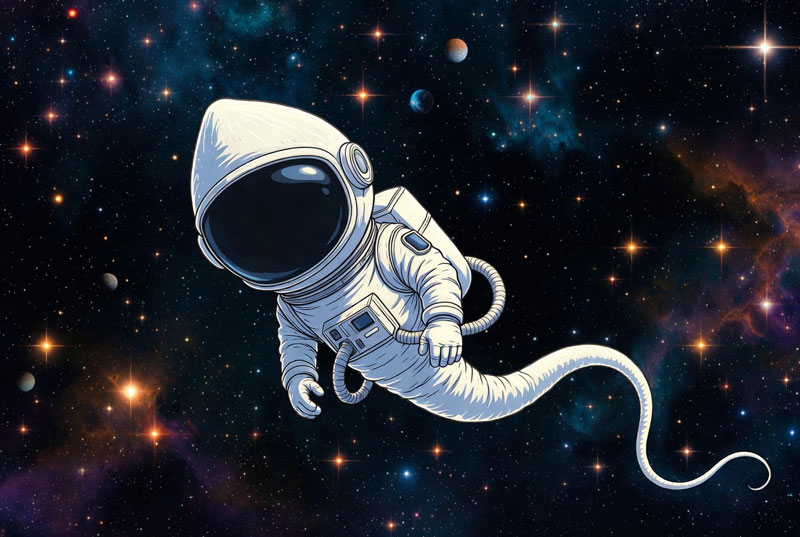
Space colonization is in danger: the lack of gravity disrupts the "navigator" of spermatozoa
News in Own Words
1. What was discovered by researchers from the University of Adelaide (Australia) first showed that microgravity seriously disrupts sperm navigation. This means fertility problems could arise not only on space stations but also in colonies on the Moon or Mars. If a way to circumvent this problem is not found, colonization plans may prove unsuccessful.
2. How the experiments were conducted* Setup – 3D clinostat: two axes of rotation change the direction of gravity inside the chamber, creating a weightless effect.
* Samples – human sperm and two species of mammals (e.g., mice).
* Test – sperm were guided through a “maze” that mimics female reproductive pathways.
3. Main results | Condition | Cell motility | Path to goal |
|---------|---------------------|-------------|
| Earth gravity | almost unchanged | most sperm reach the “goal” |
| Microgravity | almost unchanged | significantly fewer sperm reach the goal |
Thus, microgravity does not slow cell movement but destroys their orientation. Sperm behave like “blind kittens,” unaware of which way to swim.
4. The effect of progesterone hormone Dr. Nicole McFerson (first author) noted that gravity plays a key role in sperm orientation. Adding progesterone – a hormone released by the egg – partially mitigates the negative effect of microgravity and improves navigation in human sperm. This opens a path to a potential solution for reproductive problems in space, but further research is required.
5. Effects at the fertilization level* Mice – four‑hour exposure to microgravity reduces successful fertilization rates by about 30 %.
* Longer exposures (4–6 h and beyond) show delays in embryo development, and sometimes even a reduction in cell numbers at early stages.
Thus, reproduction in space turns out to be more complex than previously thought.
6. What remains hopeful Despite the problems most embryos still developed normally. This provides grounds to consider reproduction in space possible provided further research and the development of artificial gravity or adaptive biological solutions.
7. Next steps* Study the impact of different gravity levels (Moon, Mars).
* Identify threshold effects and compensation mechanisms.
* Develop artificial gravity systems for long‑term missions.
If these tasks are not solved, space colonization will either be severely hindered or impossible.
 Asted Cloud
Comments (0)
Share your thoughts — please be polite and stay on topic.
Log in to comment