
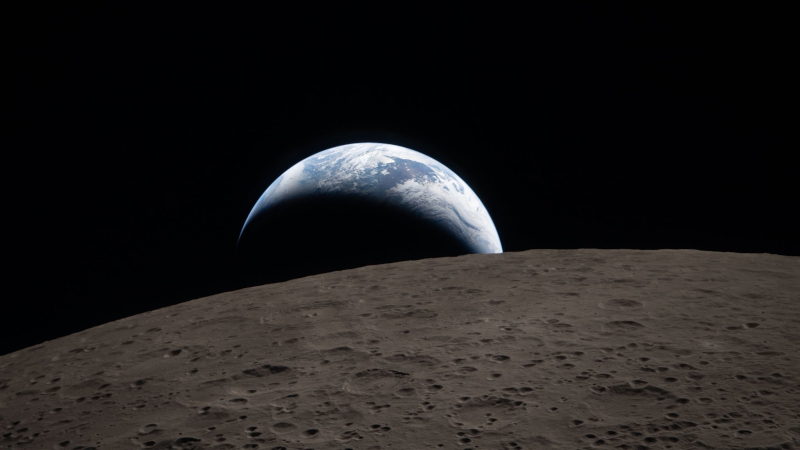
The Artemis II team observed a total solar eclipse from the Moon and sent additional stunning photographs
Frames of a total solar eclipse from space – a new Artemis II achievement
The Artemis II crew first showed images of a total solar eclipse taken during an orbital flight around the Moon. In shots from the Orion spacecraft, the Moon appears as a black sphere in the glowing halo of the Sun; the duration of the total phase is almost an hour—much longer than the few minutes seen on Earth.
What the photographs show
- Bright and dark
In one shot the lunar disk looks sharply defined, although its edge remains slightly uneven. Around it are bright stars – this is a typical view of an eclipse that can only be observed in outer space.
- Earth in shadow
Another frame captures Earth, part of which is plunged into shadow behind the lunar disk. NASA called this image “a legacy” of the photograph “Earthrise,” taken by Apollo‑8 astronauts almost sixty years ago.
Why it matters
- Duration
The total phase of the eclipse observed from the Moon lasted nearly an hour. This is because there is no distortion created by Earth’s atmosphere when viewed from space.
- New perspective
The four‑person crew saw a scene unlike the familiar view on Earth: the solar corona shone through the lunar disk without the “nebula” of the atmosphere.
Team reaction
Mission commander Reed Wiseman told NASA’s Flight Operations Center on Monday that what was seen is hard to describe. According to him, no matter how long the crew looks at this scene, “consciousness can’t keep up with it,” and there are not enough familiar words to describe the view from the viewport.
Thus, the new Artemis II frames add to existing material about Earth and the Moon, offering viewers a unique look at a total solar eclipse from deep space.
 Asted Cloud
Comments (0)
Share your thoughts — please be polite and stay on topic.
Log in to comment